AI Agent vs. Chatbot: Key Differences, Capabilities, and Uses
Chatbots focus on conversation, while AI agents can plan, use tools, and perform multi-step tasks. Learn how their capabilities, applications, and risks differ.
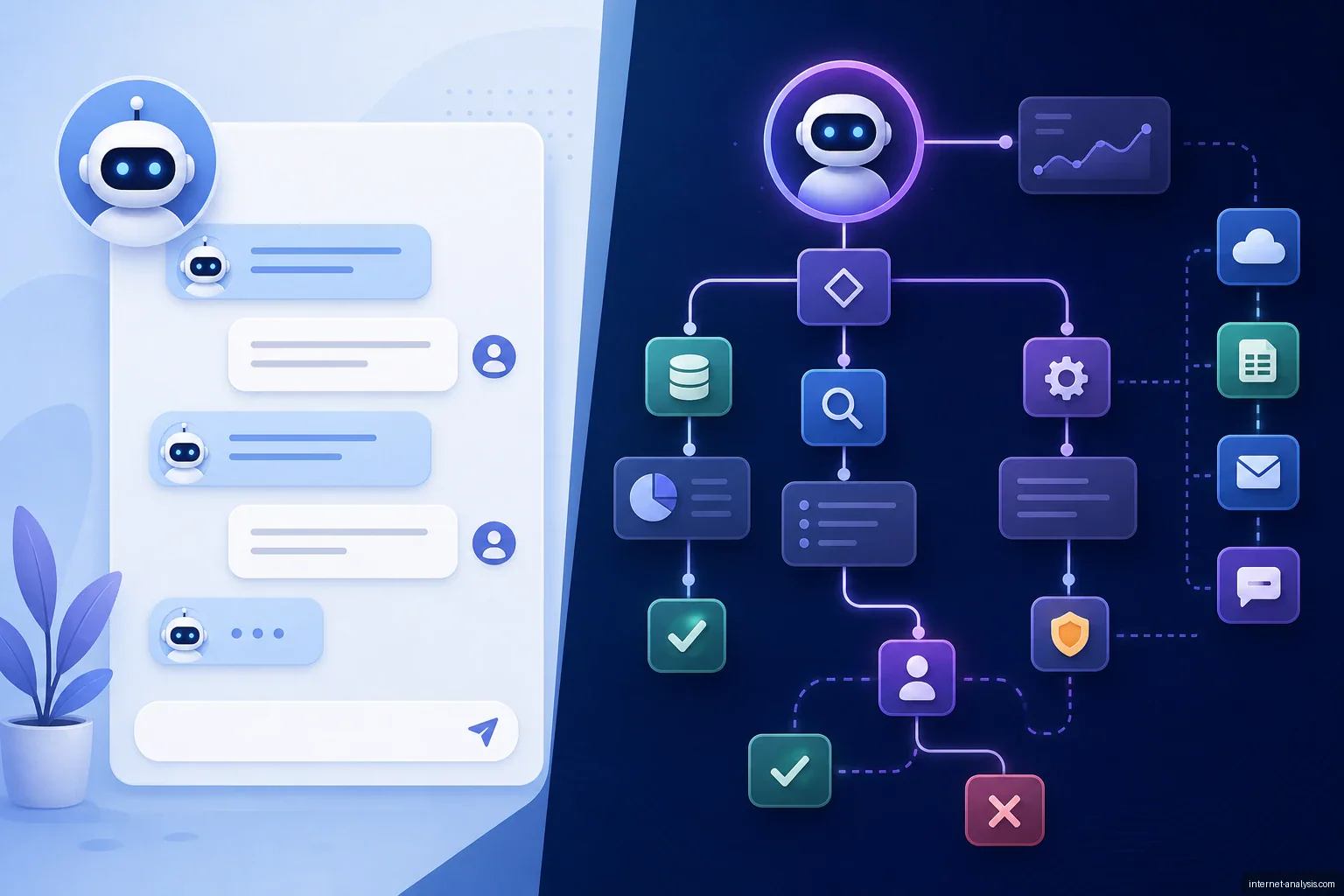
Chatbots and AI agents both use artificial intelligence to help people interact with software, but they are designed for different levels of responsibility. A chatbot primarily conducts conversations. An AI agent can use those conversations, along with data and connected tools, to pursue goals and perform actions.
The distinction matters when choosing technology for customer service, workflow automation, data analysis, or operational decision-making. A chatbot may be sufficient for answering routine questions, while a process that requires planning, tool use, and independent execution may call for an AI agent.
What is a chatbot?
A chatbot is an application designed to simulate conversation through text or voice. Traditional chatbots operate within a defined framework, matching keywords or user intents to predetermined responses and dialogue paths. Many use natural language processing to interpret requests, but their behavior remains constrained by the rules and content available to them.
These systems are effective when conversations are predictable. Common uses include answering frequently asked questions, collecting contact information, checking an order status, and directing customers to the appropriate department.
Rule-based chatbots generally do not learn from individual conversations or adapt their behavior without further development. Unexpected requests can therefore lead to repetitive answers, fallback messages, or escalation to a human representative.
How advanced chatbots differ
Modern conversational systems such as ChatGPT, Gemini, and Claude use large language models rather than relying exclusively on scripts. They can follow context, generate original responses, summarize information, assist with research, create content, and help write code.
These capabilities make advanced chatbots substantially more flexible than traditional versions. However, sophisticated conversation alone does not necessarily make a system an agent. The defining issue is whether it can independently plan and take actions through tools or connected systems, not simply whether it can produce natural language.
What is an AI agent?
An AI agent is a system designed to interpret its environment, make decisions, and take actions in pursuit of a goal. Depending on its architecture, it may analyze data, select among possible steps, call software tools, update records, and adjust its approach based on new information.
For example, instead of merely explaining how to reschedule a delivery, an agent could check available time slots, apply business rules, update the logistics platform, and notify the customer. Human approval can still be required for sensitive or high-impact actions.
Not every agent learns continuously from every interaction. Some adapt through machine-learning models, stored context, feedback mechanisms, or periodic retraining, while others operate according to fixed policies. Autonomy, learning, and access to tools are separate design choices.
AI agent vs. chatbot: the main differences
| Area | Chatbot | AI agent |
|---|---|---|
| Primary purpose | Conduct a conversation and provide information | Pursue a goal and complete tasks |
| Typical behavior | Responds to user prompts | Plans, decides, and acts across one or more steps |
| Scope | Usually limited to defined topics or conversational assistance | Can coordinate broader workflows and connected systems |
| Tool use | May retrieve information or trigger simple functions | Often uses APIs, databases, applications, and other tools |
| Adaptation | Traditional versions follow fixed scripts; advanced versions adapt responses to context | May revise plans or actions as data and conditions change |
| Human involvement | Escalates requests outside its supported scope | Can operate autonomously within defined permissions and approval rules |
| Best suited to | Frequently asked questions and routine conversations | Multi-step processes, analysis, and operational automation |
Conversation versus action
The clearest difference is what happens after the system understands a request. A chatbot usually returns an answer. An agent may decide what needs to happen, execute a sequence of steps, verify the result, and respond with an outcome.
This distinction is not absolute. A chatbot can call external services, and an agent can use a chat interface. The technologies overlap, but their center of gravity differs: chatbots emphasize communication, while agents emphasize goal-directed action.
Handling simple and complex tasks
Traditional chatbots perform well when requests can be mapped to a manageable set of intents. Their predictable behavior can also be beneficial in tightly controlled customer-service environments.
Agents are better suited to processes involving multiple systems, changing conditions, or a sequence of decisions. They can support activities such as reviewing incoming data, prioritizing work, coordinating project tasks, and preparing recommended actions.
Learning and adaptation
Rule-based chatbots typically deliver repetitive results because they do not retain experience or revise their logic automatically. Large language model chatbots can interpret context and generate more nuanced responses, although they still require appropriate data, instructions, and safeguards.
Agents can be designed to use feedback, task history, and real-time data when selecting their next action. This can make them more responsive to changing conditions, but it also introduces a need for monitoring, evaluation, and controls.
Scalability
Both technologies can process large numbers of interactions when supported by suitable infrastructure. The practical difference concerns the type of work being scaled. Chatbots scale repetitive communication; agents can scale multi-step operations.
An agent may help an organization manage a high volume of tasks, improve response times, and reduce manual handoffs. Its ability to scale safely depends on system reliability, data quality, tool capacity, permissions, and the consequences of an incorrect action.
Where chatbots are used
Chatbots are common on websites, social networks, messaging applications, and customer-support platforms. Their uses include:
- Answering routine product and service questions
- Guiding customers through common procedures
- Collecting information before a human conversation
- Providing order, account, or appointment information
- Generating, summarizing, or rewriting content
- Assisting with research and software development
ChatGPT is widely used for conversational assistance, content generation, questions, and coding tasks. Gemini provides AI assistance and works with Google services. Claude supports activities such as research, summarization, analysis, and extended discussion. Whether a deployment functions only as a chatbot or as part of an agent depends on its integrations and authority to act.
Where AI agents are used
AI agents can support automation in finance, healthcare, e-commerce, customer service, project management, and other data-intensive fields. Potential workflows include classifying documents, monitoring operational data, routing cases, coordinating schedules, and updating business systems.
Several well-known products illustrate agent-like behavior, although they differ substantially in design and autonomy:
- Amazon Alexa interprets voice requests and can retrieve information or control compatible smart-home devices.
- Apple Siri assists with voice queries, scheduling, navigation, and supported device actions.
- Tesla Autopilot uses AI and vehicle sensors to provide driver-assistance features. It requires appropriate driver supervision and should not be treated as a fully autonomous system.
- AlphaGo, developed by DeepMind, selected actions within the game of Go and defeated leading world champions, demonstrating AI's ability to master complex strategy.
These examples range from digital assistants to specialized decision systems. They show that an agent does not have to resemble a customer-service chat window; it can act through voice interfaces, software applications, vehicles, or other environments.
How AI agents incorporate chatbot features
A conversational interface is often the front end of an agent. The user states a goal in natural language, and the system determines what information or actions are required. It may then query databases, analyze real-time data, call an application programming interface, or request approval before completing the task.
A typical interaction can follow this sequence:
- The chatbot interface receives and interprets the request.
- The agent identifies the goal, constraints, and missing information.
- It creates or selects a plan.
- Connected tools perform approved actions.
- The agent checks the result and reports it conversationally.
This combination provides the accessibility of chat and the operational reach of automation. It also makes clear why permissions matter: a system that can change a record, send a message, or initiate a transaction carries more risk than one that only recommends an action.
Which technology should a business choose?
A chatbot is usually the better fit when the objective is to provide fast, consistent answers within a limited scope. It is often simpler to implement, test, and govern, particularly when it follows predetermined content.
An AI agent is more appropriate when the desired outcome requires several steps, access to current data, coordination across software tools, or decisions within defined business rules. Before granting autonomy, organizations should determine which actions the system may perform, when human approval is mandatory, and how failures will be detected and reversed.
In many deployments, the best choice is not one or the other. A chatbot can handle routine communication, while an agent performs approved work behind the interface and transfers exceptional cases to employees.
Challenges of building AI agents
Agents are more operationally powerful than standalone chatbots, but that power increases design and governance requirements. Key challenges include:
- Data privacy: Sensitive information must be collected, stored, and processed appropriately.
- Security and permissions: Tool access should be limited to the actions and data required for the task.
- Reliability: The system must handle incomplete information, tool failures, and unexpected conditions.
- Ethical use: Decisions should be assessed for unfair outcomes, inappropriate automation, and potential harm.
- Data diversity and quality: Models and workflows must interpret varied inputs without relying on inaccurate or incomplete datasets.
- Human oversight: High-impact actions may need review, escalation paths, and audit records.
Organizations must balance automation with accountability. Increasing an agent's autonomy can reduce manual work, but it also raises the consequences of incorrect decisions.
Frequently asked questions
Can a chatbot become an AI agent?
A chatbot does not transform into an agent by itself, but developers can extend it with planning logic, memory, machine-learning capabilities, connected tools, and permission to perform actions. The conversational interface can remain the same even as the underlying system becomes more agentic.
Which industries use AI agents?
Agents are being applied in sectors including finance, healthcare, e-commerce, and customer service. Their suitability depends less on the industry label than on whether a process has clear goals, accessible data, defined rules, and manageable risks.
How do chatbots and agents affect business automation?
Chatbots automate communication and routine information delivery. Agents can extend automation into execution by responding to data, coordinating systems, and completing tasks. Together, they can reduce repetitive work and accelerate service, provided they are properly monitored.
What is the simplest way to distinguish them?
Ask what the system is expected to deliver. If the main output is a conversational response, it is functioning as a chatbot. If it can decide on and carry out a sequence of actions to achieve a goal, it is functioning as an AI agent.

Anna
Digital Safety & Consumer Research Editor at Internet AnalysisAnna edits practical guidance about safer internet use, privacy, online services, and consumer decisions. She prioritizes clear recommendations, scope, and transparent sourcing.
View author profile →How this article was prepared
Reviews claims against named primary or authoritative sources, removes unsupported certainty, distinguishes general education from professional advice, and records the article update date.
Read our methodology →Reviewed by the Internet Analysis Editorial Team
Reviewed by the Internet Analysis Editorial Team · Updated August 28, 2026
Meet the editorial team →Article context, review and related questions
Chatbots focus on conversation, while AI agents can plan, use tools, and perform multi-step tasks. Learn how their capabilities, applications, and risks differ.
| Measure | Value | Context |
|---|---|---|
| Article type | Artificial Intelligence | Editorial classification |
| Reading time | 8 minutes | Estimated at approximately 220 words per minute |
| Editorial review | Internet Analysis Editorial Team | Updated August 28, 2026 |
| Review date | August 28, 2026 | Latest stored article update |
Methodology
Reviews claims against named primary or authoritative sources, removes unsupported certainty, distinguishes general education from professional advice, and records the article update date.
Full methodology →Data freshness
- Page updated
- Data period
- August 28, 2026
- Responsible editor
- AnnaDigital Safety & Consumer Research Editor
Primary sources
- Internet Analysis editorial methodologyReview and limitation rules
Limitations
- The article is informational and may simplify technical details for readability.
- Products, standards, prices and service availability can change after the review date.
- The latest review date does not guarantee that every external product or service remains unchanged.
Related questions
What is the main point of “AI Agent vs. Chatbot: Key Differences, Capabilities, and Uses”?
Chatbots focus on conversation, while AI agents can plan, use tools, and perform multi-step tasks. Learn how their capabilities, applications, and risks differ.
How was this article prepared?
Reviews claims against named primary or authoritative sources, removes unsupported certainty, distinguishes general education from professional advice, and records the article update date.
When was this information last reviewed?
The latest stored review or update date is August 28, 2026.