AI Agents Explained: How They Work, Types, Applications, and Risks
Learn how AI agents perceive, plan, use tools, and act, along with their major types, business applications, benefits, limitations, and governance risks.
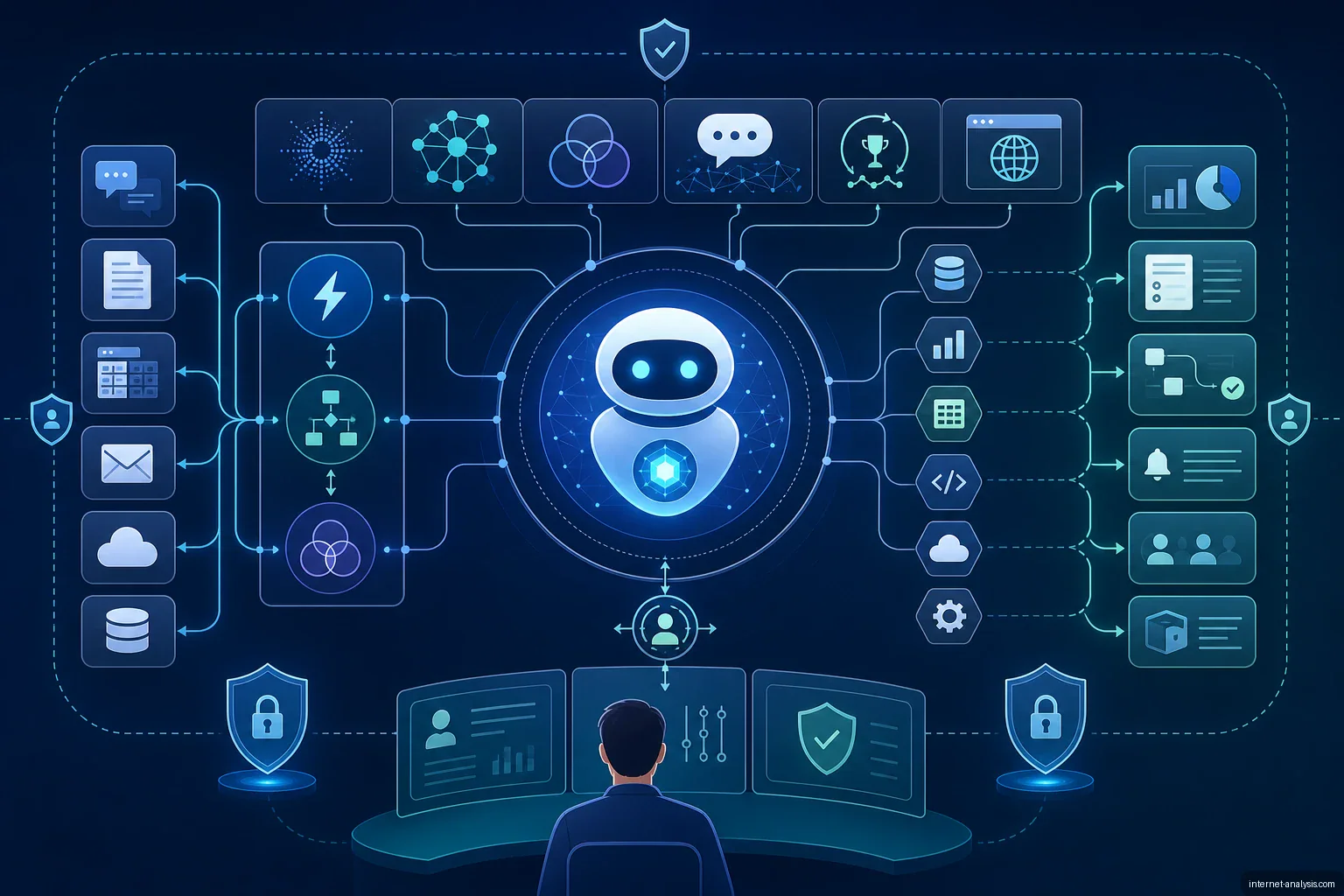
AI agents are software systems that use artificial intelligence to pursue goals, make decisions, and take actions with varying degrees of independence. Instead of producing a single prediction or response, an agent can often complete a sequence of steps, evaluate the results, and decide what to do next.
This combination of reasoning, autonomy, and access to tools makes agents useful for tasks ranging from customer support and data analysis to robotics and browser automation. Their capabilities, however, depend heavily on how they are designed, what data and tools they can access, and which safeguards govern their actions.
What Is an AI Agent?
An AI agent is a program that perceives information about its environment, selects actions in pursuit of an objective, and carries out those actions. Its environment might be a physical space, a website, a software platform, a database, or a simulated world.
Three characteristics commonly distinguish agents from conventional software:
- Autonomy: The system can perform at least some tasks without continuous human direction.
- Responsiveness: It can react to new information, events, or changes in its environment.
- Adaptability: Depending on its architecture, it may adjust its strategy based on feedback, context, stored knowledge, or learned behavior.
Autonomy is not absolute. Some agents operate independently within narrow limits, while others pause for approval before consequential actions such as submitting a payment, changing business records, or sending a message.
How AI Agents Work
Most agent workflows can be described as a repeating cycle:
- Perceive: Collect input from text, sensors, databases, application programming interfaces, or visual interfaces.
- Interpret: Identify relevant information and estimate the current state of the environment.
- Plan: Select a goal, break it into steps, and compare possible actions.
- Act: Use an available tool, generate a response, control a device, or update a system.
- Evaluate: Check the result, correct errors when possible, and determine whether another step is required.
An agent's architecture may include a model, instructions, short-term context, persistent memory, planning logic, tool integrations, and safety controls. These components determine what the agent can observe, what it is permitted to do, and how reliably it can pursue its objective.
Core Technical Approaches
- Model-based reasoning: The agent maintains a representation of its environment and uses it to predict the likely effects of potential actions.
- Reinforcement learning: The agent learns a policy through feedback, typically represented as rewards or penalties.
- Neural networks: Models identify patterns in data and can support perception, prediction, language processing, and decision-making.
These approaches can be combined. For example, an agent may use a neural network to interpret an image, a language model to create a plan, and reinforcement-learning techniques to improve decision strategies.
Supporting Technologies
AI agents commonly draw on several branches of artificial intelligence:
- Machine learning helps systems identify patterns and improve model performance from data.
- Natural language processing allows agents to interpret instructions, retrieve textual information, and communicate in human language.
- Computer vision enables agents to interpret images, video, screens, and physical surroundings.
Tool integrations are equally important. An agent connected to a calendar, customer relationship management platform, web browser, or internal database can take practical actions rather than merely describe what a user should do.
Reinforcement-Learning Agents and Language-Model Agents
Reinforcement-learning and language-model agents overlap in some systems, but they are based on different concepts.
| Approach | How it operates | Typical applications |
|---|---|---|
| Reinforcement-learning agent | Learns strategies through interactions and feedback represented by rewards or penalties | Robotics, games, resource allocation, and autonomous control |
| Language-model agent | Uses a model such as GPT to interpret language, reason over context, create plans, and call tools | Customer support, research assistance, content workflows, and browser-based tasks |
A reinforcement-learning agent can improve its behavior by repeatedly operating in an environment during training. A language-model agent does not necessarily update its underlying model when it finds information during a task. Information placed in its temporary context may help with the current interaction, but it does not automatically become permanent model knowledge. Persistent learning requires a separate process, such as saving information to memory, updating a retrieval system, or retraining the model.
Major Types of AI Agents
Reactive Agents
Reactive agents respond to current conditions without extensive planning or a detailed memory of previous events. A robot vacuum is a familiar example: its sensors detect obstacles, and the control system immediately adjusts its movement.
This approach is fast and practical for clearly defined environments, but it is less suitable for tasks that require long-term strategy.
Deliberative Agents
Deliberative agents create or use a model of their environment, consider possible outcomes, and plan actions. Driver-assistance systems illustrate some elements of this approach by processing sensor data, estimating the behavior of nearby road users, and planning vehicle movements. Such systems still require strict safety controls and must be used within their defined operating limits.
Hybrid Agents
Hybrid agents combine immediate reactions with longer-term planning. A system might respond instantly to an urgent event while continuing to work toward a broader objective. This design is useful in changing environments where speed and strategic reasoning are both important.
Browser-Using Agents
Browser agents extend language-model capabilities by allowing a system to interpret and interact with graphical web interfaces. They can potentially navigate pages, select controls, enter information, and complete multistep workflows.
OpenAI introduced Operator as a research-preview browser agent powered by its Computer-Using Agent model. The system combined GPT-4o's visual capabilities with reinforcement-learning-based reasoning and was demonstrated performing tasks such as ordering groceries, booking tickets, and completing forms. It was initially offered to Pro users in the United States, with plans for broader availability and integration with ChatGPT.
Operator was designed to let users take control and to request assistance for sensitive steps, including payment details and CAPTCHAs. These handoff mechanisms illustrate an important principle: useful autonomy should be paired with human oversight when actions carry financial, legal, privacy, or security consequences.
Everyday and Business Applications
AI agents can support both customer-facing and internal workflows. Common applications include:
- Customer service: Answering questions, classifying requests, retrieving account information, and escalating difficult cases.
- Personal assistance: Managing reminders, interpreting voice commands, and coordinating routine tasks.
- Manufacturing: Monitoring equipment, detecting anomalies, and helping automate production processes.
- Finance: Supporting risk analysis, transaction monitoring, and fraud detection.
- E-commerce: Personalizing recommendations, assisting shoppers, and processing service requests.
- Healthcare: Organizing records and supporting clinical or administrative analysis under appropriate professional oversight.
- Knowledge work: Searching internal information, summarizing documents, preparing drafts, and coordinating software tools.
Voice assistants such as Siri and customer-service chatbots are familiar forms of agent-like software. More advanced systems go beyond conversation by invoking tools and completing actions across connected applications.
Business Benefits
Continuous Availability
Automated agents can operate around the clock without shift breaks, helping organizations respond to requests outside normal business hours. This does not make them cost-free: deployment still requires computing infrastructure, software maintenance, monitoring, security, and human support.
Faster Data Processing
Agents can analyze large datasets, retrieve relevant records, and produce recommendations more quickly than manual workflows in suitable use cases. Potential advantages include:
- More consistent execution of standardized tasks
- Faster access to operational insights
- Scalability as request or data volumes grow
- Reduced manual effort in repetitive processes
Results should still be validated when errors could cause material harm. AI can produce incorrect conclusions, misunderstand context, or act on incomplete data.
Customization With Company Data
An agent connected to approved company information can provide answers and actions tailored to internal processes, products, and customer needs. This customization may use retrieval systems, carefully designed instructions, tool integrations, model fine-tuning, or a combination of methods.
Organizations should not assume that simply exposing an agent to data permanently trains it. Temporary context, searchable knowledge stores, and model training are distinct mechanisms with different cost, privacy, and maintenance implications.
Long-Term Efficiency
Automation can reduce the time employees spend on repetitive work and allow them to focus on judgment-intensive, creative, or strategic responsibilities. Whether an implementation saves money depends on its accuracy, operating costs, integration requirements, oversight needs, and the value of the process being automated.
Risks and Governance
Giving an AI system permission to act introduces risks beyond those associated with a standalone prediction or chatbot response. Organizations should consider:
- Privacy: Agents may process personal, confidential, or regulated information.
- Security: Tool access can expose systems to unauthorized actions, malicious instructions, or data leakage.
- Algorithmic bias: Flawed or unrepresentative data can produce unfair outcomes.
- Reliability: Models can generate inaccurate information or choose an unsuitable action.
- Workforce effects: Automation may change roles, skills requirements, and staffing needs.
- Accountability: Organizations must define who is responsible for reviewing decisions and correcting errors.
Risk controls can include limited permissions, identity and access management, audit logs, testing, algorithmic audits, data minimization, transparent user disclosures, and mandatory human approval for high-impact actions. The greater an agent's autonomy and access, the stronger its governance should be.
Frequently Asked Questions
How is an AI agent different from a conventional AI model?
A model generally maps input to output, such as generating text or classifying an image. An agent wraps one or more models in a system that can pursue goals, maintain context, make plans, use tools, and perform multiple actions. Not every AI application is an agent, and not every agent learns continuously.
How does an agent improve?
Improvement can come from reinforcement learning, model retraining, better prompts and policies, upgraded tools, expanded retrieval data, stored memory, or feedback from users and evaluators. The appropriate method depends on the architecture. Information discovered during one language-model session does not automatically update the underlying model.
Which industries can benefit?
Manufacturing, finance, e-commerce, customer service, healthcare, and other data-intensive sectors can benefit when they have well-defined processes, reliable data, and suitable oversight. The best opportunities usually involve repetitive, measurable tasks rather than decisions that require unbounded autonomy or unsupported judgment.
Should an AI agent operate without human supervision?
That depends on the consequences of an error. Low-risk, reversible tasks may allow more autonomy. Payments, medical decisions, access changes, legal commitments, and other sensitive actions generally warrant approval steps, clear limits, and human review.
Choosing an Appropriate Agent Use Case
A strong implementation begins with a narrow objective and a clear definition of success. Before deployment, an organization should identify the required data, tools, permissions, escalation paths, and acceptable error rate. Testing should cover normal operation as well as ambiguous requests, unavailable tools, malicious inputs, and failed actions.
AI agents can make software more proactive and capable, but their value does not come from autonomy alone. Effective systems combine appropriate models, reliable integrations, carefully bounded permissions, and meaningful human oversight.

Tomasz
Founder & Network Data Analyst at Internet AnalysisTomasz leads data-focused analysis at Internet Analysis, covering internet speed, latency, reliability, broadband infrastructure, and ISP performance. His work connects measurable network indicators with clear explanations for everyday users.
View author profile →How this article was prepared
Reviews measurement definitions, compares like-for-like network samples, checks geographic and time coverage, and documents limitations before drawing conclusions.
Read our methodology →Reviewed by the Internet Analysis Editorial Team
Reviewed by the Internet Analysis Editorial Team · Updated August 28, 2026
Meet the editorial team →Article context, review and related questions
Learn how AI agents perceive, plan, use tools, and act, along with their major types, business applications, benefits, limitations, and governance risks.
| Measure | Value | Context |
|---|---|---|
| Article type | Artificial Intelligence | Editorial classification |
| Reading time | 8 minutes | Estimated at approximately 220 words per minute |
| Editorial review | Internet Analysis Editorial Team | Updated August 28, 2026 |
| Review date | August 28, 2026 | Latest stored article update |
Methodology
Reviews measurement definitions, compares like-for-like network samples, checks geographic and time coverage, and documents limitations before drawing conclusions.
Full methodology →Data freshness
- Page updated
- Data period
- August 28, 2026
- Responsible editor
- TomaszFounder & Network Data Analyst
Primary sources
- Internet Analysis editorial methodologyReview and limitation rules
Limitations
- The article is informational and may simplify technical details for readability.
- Products, standards, prices and service availability can change after the review date.
- The latest review date does not guarantee that every external product or service remains unchanged.
Related questions
What is the main point of “AI Agents Explained: How They Work, Types, Applications, and Risks”?
Learn how AI agents perceive, plan, use tools, and act, along with their major types, business applications, benefits, limitations, and governance risks.
How was this article prepared?
Reviews measurement definitions, compares like-for-like network samples, checks geographic and time coverage, and documents limitations before drawing conclusions.
When was this information last reviewed?
The latest stored review or update date is August 28, 2026.