How AI Knowledge Bases Can Accelerate Business Operations
AI knowledge bases combine semantic search, natural language processing and conversational tools such as ChatGPT to make company information easier to retrieve, manage and apply securely.
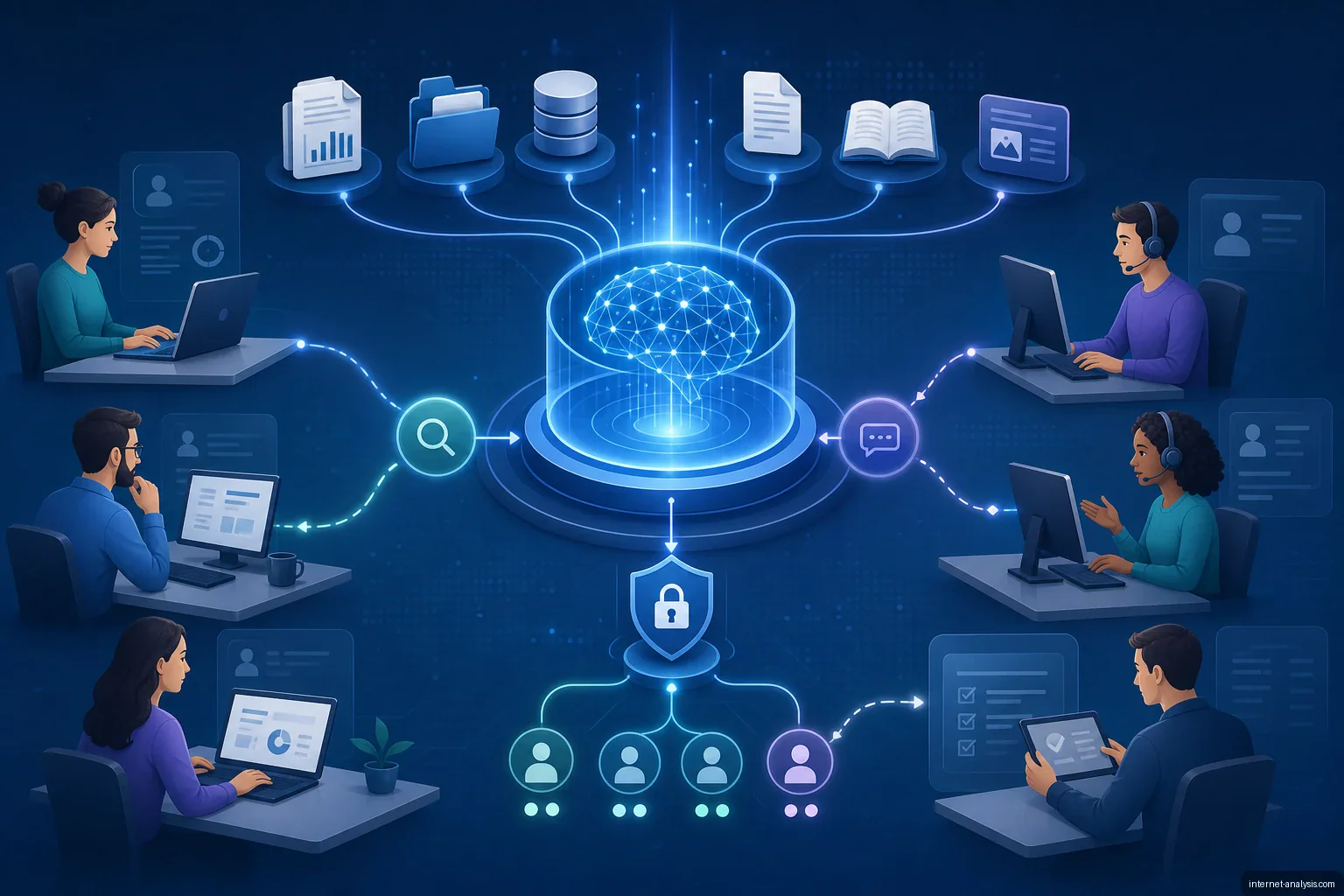
Companies generate large volumes of documentation, policies, project records, support materials and institutional knowledge. The challenge is not simply storing that information; it is helping employees and customers retrieve the right answer quickly and reliably.
An AI-powered knowledge base addresses this problem by combining organized business content with semantic search, natural language processing and machine learning. When conversational technology such as ChatGPT is added, users can ask questions in everyday language instead of navigating folders or guessing exact keywords.
What is an AI knowledge base?
An AI knowledge base is a digital repository that uses artificial intelligence to organize, search and retrieve information. Unlike a conventional database or document library, it can interpret the meaning of a request and identify relevant material even when the user’s wording does not exactly match the source text.
These systems commonly use vector databases. Documents and queries are represented numerically, allowing the system to compare their semantic meaning rather than relying exclusively on keyword matches. Advanced search algorithms then identify relevant passages that can be presented directly or used to generate an answer.
Natural language processing makes the experience more conversational. An employee might ask, “How do I request equipment for a new hire?” rather than search for a precisely named procurement policy. The system can interpret the question, locate related company materials and return a focused response.
With specialist oversight, feedback and user interactions can also inform improvements. Teams can identify recurring questions, missing documents and weak answers, then refine the source material or retrieval process. This supervised approach helps the knowledge base adapt without treating every interaction as automatically correct.
Business benefits of an AI-powered knowledge base
Centralizing information and making it easier to search can reduce the time employees spend looking through documents or asking colleagues for routine assistance. The most important operational benefits include:
- Faster information retrieval: Semantic search helps users find relevant answers without knowing an exact document title, folder location or keyword.
- More efficient onboarding: New employees can consult established training materials, policies and frequently asked questions before escalating routine requests to coworkers.
- Better-informed decisions: Easier access to current, accurate business information gives teams a stronger basis for operational choices.
- Consistent internal support: A shared repository can provide the same approved guidance across departments and locations.
- Customer service automation: A customer-facing implementation can answer common questions quickly while directing complex or sensitive cases to human support staff.
The value of the system still depends on the underlying content. AI cannot compensate for missing, contradictory or outdated documents, so information governance remains a core part of implementation.
How ChatGPT works with a business knowledge base
ChatGPT can serve as the conversational layer between users and company information. Instead of manually browsing repositories, users enter a question in a chat interface. The application interprets the request, searches approved materials and produces a readable response based on the information it retrieves.
A typical integration includes several components:
- Business content: The organization selects documents, frequently asked questions, manuals and other relevant materials for the system to use.
- Content processing: Files are divided into searchable sections and converted into representations suitable for semantic retrieval.
- Retrieval: When a question is submitted, the system finds the passages most closely related to its meaning.
- Response generation: ChatGPT uses the retrieved context to formulate a natural-language answer.
- User interface: A custom chat experience can reflect the company’s branding and fit into existing employee or customer workflows.
- Supervised improvement: Specialists review usage patterns, feedback and unsuccessful searches to improve documents, prompts and retrieval settings.
Organizations may also adapt or train models with specialized data where appropriate. In many knowledge-base scenarios, however, retrieving current material at query time is important because business documents change. Regardless of the technical method, responses should be grounded in approved sources and governed by access permissions.
Key capabilities
Natural-language questions
Users can phrase requests informally instead of learning a rigid search syntax. This lowers the barrier to finding policies, procedures and technical guidance.
Semantic search
Vector-based retrieval can connect related concepts even when the query and source document use different terminology. Keyword search may still be useful and can be combined with semantic methods.
Multilingual interaction
ChatGPT can communicate in multiple languages, making a knowledge base more accessible to geographically distributed workforces and customer groups. Organizations should still validate translations and domain-specific terminology.
Data analysis and trend identification
Usage data can reveal common questions, repeated support issues and gaps in documentation. Depending on the available data and system design, AI can also assist with analyzing large information sets and surfacing patterns for review.
Personalized, context-aware responses
A well-designed system can tailor information to a user’s role, department or previous context. Personalization must remain subject to authorization rules so that convenience does not expose restricted material.
Common implementation scenarios
Employee onboarding
A new hire can ask about internal tools, benefits, workflows or administrative procedures and receive guidance from existing materials. This reduces repeated questions while keeping human support available for situations that require judgment.
Internal operations
Employees can use the system to retrieve project procedures, technical instructions, policies and organizational knowledge. This is especially useful when information is distributed across multiple repositories.
Customer support
A customer-facing knowledge base can automate responses to frequently asked questions and provide consistent service at scale. Escalation paths should be available when the system lacks sufficient information or when a request involves account-specific, sensitive or complex issues.
Building a reliable knowledge base
The quality of an AI assistant begins with the quality of its source material. Before introducing a conversational interface, organizations should establish a clear process for collecting, organizing and maintaining content.
- Create a logical information structure: Use clear categories, tags and ownership rules so content remains manageable.
- Remove duplication and contradictions: Conflicting source documents can lead to inconsistent answers.
- Assign content owners: Specific teams or specialists should be responsible for accuracy and approval.
- Update materials regularly: Policies, product details and procedures should be reviewed to prevent outdated guidance.
- Design for usability: The interface should make it easy to ask questions, refine requests and recognize when further assistance is needed.
- Monitor performance: Track unanswered questions, poor retrieval results and user feedback to identify areas for improvement.
Privacy and security requirements
A business knowledge base may contain confidential information about employees, customers, operations and projects. Security therefore has to be part of the architecture rather than an optional feature added after deployment.
Important safeguards include:
- Encryption: Protect information during transmission and while it is stored.
- Authentication: Verify the identity of each user before granting access.
- Role-based access controls: Ensure users can retrieve only the material their roles permit them to view.
- Sensitive-data protection: Identify and appropriately handle confidential or regulated information.
- Logging and monitoring: Record relevant activity so suspicious behavior and operational problems can be investigated.
- Regulatory compliance: Configure data handling, retention and access practices to meet applicable laws and industry requirements.
- Human governance: Establish responsibility for reviewing content, permissions, system behavior and reported problems.
A secure deployment can make information broadly available to authorized users without making it universally accessible. Strong privacy controls also encourage adoption by giving employees greater confidence that company and personal data are handled responsibly.
Planning for scale
As a company grows, its knowledge base must support more content, users, languages and use cases. Scalability involves more than increasing storage capacity. The organization must preserve search quality, permissions and content accuracy as the repository expands.
Three practices are particularly important:
- Expand approved sources deliberately: Add new repositories and materials through a managed ingestion and review process.
- Observe how people use the system: Analyze common questions, failed searches and feedback to guide improvements.
- Maintain the conversational layer: Refine the ChatGPT integration as terminology, processes and user needs evolve.
Frequently asked questions
What makes an AI knowledge base different from a traditional repository?
A traditional repository primarily stores and categorizes information. An AI knowledge base adds technologies such as natural language processing, semantic search and machine learning to interpret questions and retrieve relevant content based on meaning.
How can ChatGPT improve a company knowledge base?
ChatGPT gives employees or customers a conversational way to access information. Users can ask questions in everyday language, and the system can turn retrieved material into a focused response. With appropriate oversight, usage patterns can also help teams recognize frequent questions and improve weak or missing documentation.
Can an AI knowledge base be secure?
Yes, provided it is designed and operated with appropriate safeguards. Encryption, authentication, access controls, monitoring and careful data governance can reduce risk and restrict confidential information to authorized users. Security depends on the implementation and must be maintained continuously.
Does the system improve automatically?
Interactions and feedback can provide useful signals, but business knowledge systems should not absorb every user exchange without review. Specialist supervision is needed to validate changes, correct errors and ensure that future answers remain accurate and compliant.
Turning stored information into operational value
An AI knowledge base can make business information faster and easier to use, whether the goal is employee onboarding, internal support, customer service or better access to operational guidance. ChatGPT strengthens that experience by letting users interact with approved content conversationally.
Successful adoption depends on more than the language model. Organizations need well-maintained source documents, effective retrieval, intuitive design, rigorous security and ongoing human oversight. When those elements work together, a knowledge base becomes more than a document archive: it becomes a practical tool for applying organizational knowledge across daily operations.

Anna
Digital Safety & Consumer Research Editor at Internet AnalysisAnna edits practical guidance about safer internet use, privacy, online services, and consumer decisions. She prioritizes clear recommendations, scope, and transparent sourcing.
View author profile →How this article was prepared
Reviews claims against named primary or authoritative sources, removes unsupported certainty, distinguishes general education from professional advice, and records the article update date.
Read our methodology →Reviewed by the Internet Analysis Editorial Team
Reviewed by the Internet Analysis Editorial Team · Updated August 28, 2026
Meet the editorial team →Article context, review and related questions
AI knowledge bases combine semantic search, natural language processing and conversational tools such as ChatGPT to make company information easier to retrieve, manage and apply securely.
| Measure | Value | Context |
|---|---|---|
| Article type | Enterprise Technology | Editorial classification |
| Reading time | 8 minutes | Estimated at approximately 220 words per minute |
| Editorial review | Internet Analysis Editorial Team | Updated August 28, 2026 |
| Review date | August 28, 2026 | Latest stored article update |
Methodology
Reviews claims against named primary or authoritative sources, removes unsupported certainty, distinguishes general education from professional advice, and records the article update date.
Full methodology →Data freshness
- Page updated
- Data period
- August 28, 2026
- Responsible editor
- AnnaDigital Safety & Consumer Research Editor
Primary sources
- Internet Analysis editorial methodologyReview and limitation rules
Limitations
- The article is informational and may simplify technical details for readability.
- Products, standards, prices and service availability can change after the review date.
- The latest review date does not guarantee that every external product or service remains unchanged.
Related questions
What is the main point of “How AI Knowledge Bases Can Accelerate Business Operations”?
AI knowledge bases combine semantic search, natural language processing and conversational tools such as ChatGPT to make company information easier to retrieve, manage and apply securely.
How was this article prepared?
Reviews claims against named primary or authoritative sources, removes unsupported certainty, distinguishes general education from professional advice, and records the article update date.
When was this information last reviewed?
The latest stored review or update date is August 28, 2026.