The 8 Biggest Challenges Facing the DOOH Industry in 2026
Eight economic, technical and strategic issues shaping DOOH in 2026, including hardware pricing, fragmented systems, cybersecurity, skills shortages and content performance.
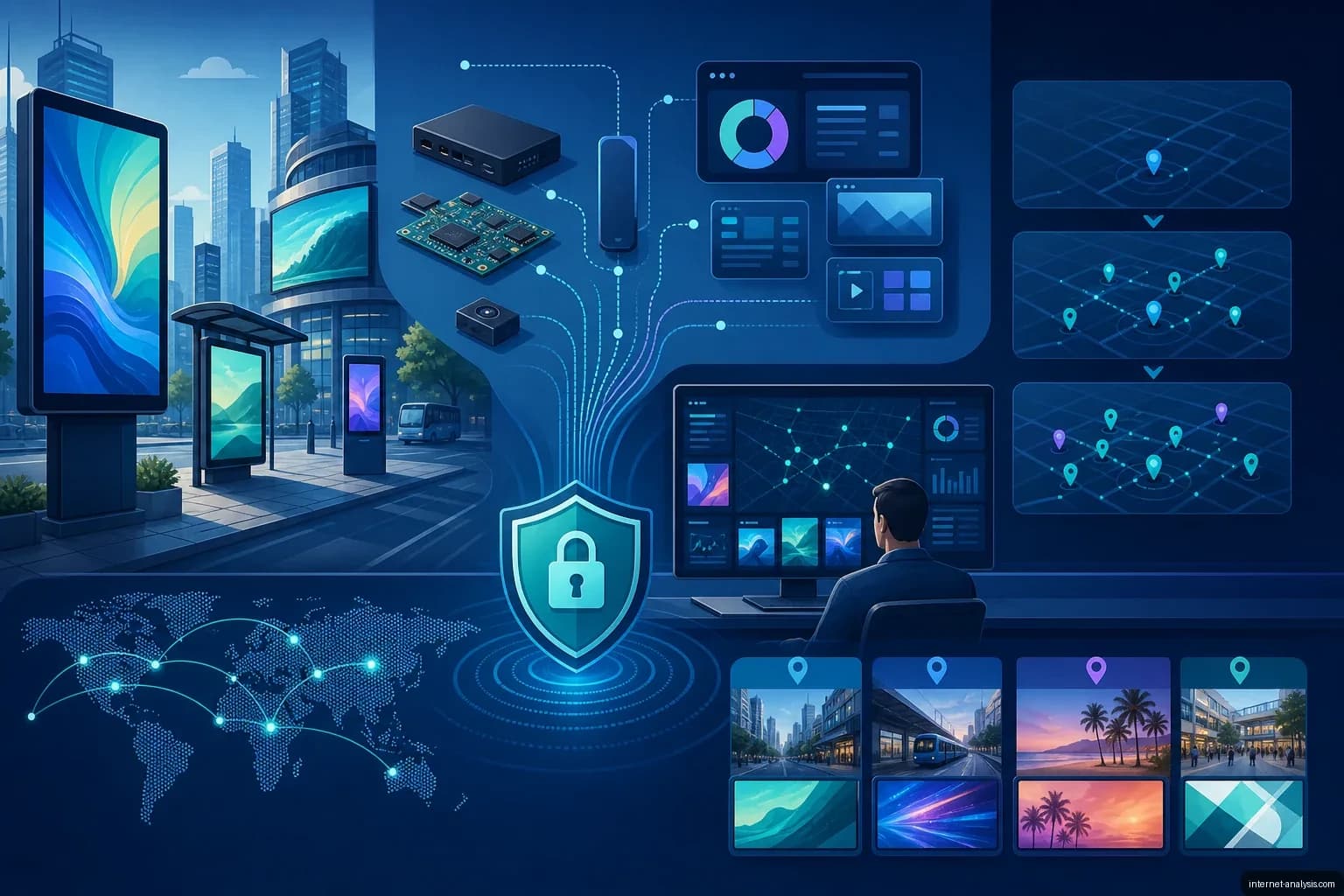
Digital out-of-home advertising is becoming a larger and more technically sophisticated part of the advertising market. The global DOOH market is expected to exceed $24 billion in 2026, with annual growth reaching double digits. Urbanization, smart-city infrastructure and the replacement of static billboards with digital displays are helping drive that expansion.
Programmatic buying and real-time audience measurement are also moving into the mainstream. For advertisers and agencies, that creates new opportunities to reach people outside the home, adjust campaigns using data and measure performance more precisely.
Growth, however, is exposing weaknesses throughout the DOOH ecosystem. Network operators and integrators must deploy screens, connect disparate technologies, secure public-facing devices, sell advertising inventory and demonstrate a return on investment—all while controlling costs. Eight challenges will be especially important in 2026.
Economic and competitive pressures
DOOH buyers increasingly expect brighter displays, smarter content delivery and better measurement without corresponding budget increases. Fast procurement cycles and shrinking margins are pushing integrators toward standardized systems, but reducing costs cannot come at the expense of reliability.
1. Price pressure from lower-cost hardware
Lower-cost LCD and LED products from Asian manufacturers have changed how many DOOH contracts are awarded. Purchasing decisions often emphasize acquisition price and technical specifications, while reliability, service quality and support response times receive less attention.
That trade-off can create risks that become visible only after a large network has been deployed:
- Margins leave less room for essential work. When integrators compete primarily on hardware costs, less funding remains for commissioning, configuration testing and long-term support.
- Maintenance expenses may be underestimated. Less expensive displays can bring shorter warranties, difficulty sourcing replacement parts, more failures and longer periods of downtime.
- Resilience becomes harder to sell. Clients focused on the initial price may resist service-level agreements, backup systems and local service coverage, even though these measures help keep revenue-producing screens operational.
The more useful comparison is therefore not purchase price alone, but total operating cost. Availability, maintainability, warranty coverage, service response times and expected downtime all influence whether a screen network can generate dependable revenue.
2. Fragmented hardware and software ecosystems
Most modern DOOH networks combine products from several vendors, including displays, media players, sensors, content management systems and monitoring platforms. Each component may have its own protocols, licensing terms, update schedules and administrative portal.
This fragmentation extends integration timelines and creates costs that may not appear in the original project budget. Technical teams must manage several vendor accounts, track separate licenses and reconcile monitoring data from tools that were not designed to work together.
Components can operate correctly in isolation and still fail when combined. A routine software update may change a protocol, introduce a driver conflict or disrupt communication between a player and its CMS. Testing must therefore cover complete configurations rather than individual products.
Integrators can reduce this uncertainty by maintaining standardized reference architectures and lists of validated devices. Proven combinations shorten commissioning, make failures easier to diagnose and limit the number of variables involved in support.
3. The move from large rollouts to phased deployment
Many clients now prefer to introduce DOOH networks in stages instead of funding a single large-scale rollout. This approach can reduce financial risk and provide evidence that a concept works before more capital is committed. It also requires the network, CMS and installation standards to support expansion from the beginning.
Phase 1: Pilot and business validation
The first stage tests the concept and establishes whether further investment is justified. Teams can assess content effectiveness while collecting real-world information about audience engagement, advertising exposure time and sales impact.
Phase 2: Standardization and operational improvement
After the pilot demonstrates value, the emphasis shifts to repeatable deployment. Organizations can select long-term vendors, negotiate volume pricing, establish service procedures and improve the operational tools used to manage the network.
Phase 3: Analytics and programmatic advertising
Later phases may introduce audience measurement, advanced analytics and programmatic ad sales. At this point, the installation develops from a content distribution system into a revenue platform supported by audience and playback data.
A modular architecture also allows individual parts of the system to be upgraded without replacing the entire network. That protects the initial investment and gives operators more flexibility as technologies and business requirements change.
Technical complexity and integration
DOOH is no longer primarily an audiovisual installation task. Successful projects require coordinated planning across AV, IT, advertising operations and facilities management. Systems must remain compatible, secure and supportable throughout their working lives.
4. Integrating multiple operational systems
A DOOH deployment may include displays, media players, a CMS, local and wide-area networks, proof-of-play tools, analytics services and advertising platforms. Every additional layer introduces dependencies involving authentication, connectivity, timing and data formats.
- Displays and media players must maintain reliable connections without software conflicts.
- CMS platforms need secure API access to distribute content and receive playback confirmations.
- Proof-of-play systems depend on accurate time synchronization and consistent event logging across devices.
- Advertising platforms must support real-time bidding and impression tracking without disrupting scheduled content.
- Building infrastructure must provide sufficient power, cooling and network capacity for continuously operating media equipment.
Existing buildings may not have been designed for this sustained electrical, thermal and network load. Infrastructure requirements should consequently be assessed before installation rather than after performance problems emerge.
Laboratory testing is also essential. Teams should reproduce the intended production configuration, test failure scenarios and document which vendor is responsible for each system boundary. Clear ownership prevents support requests from circulating among suppliers when an incident affects several components.
5. Rapid changes in AV technology
Display and playback technologies continue to advance through smaller LED pixel pitches, higher refresh rates, HDR, more capable embedded processors and improved remote management. These developments raise the quality standard, but they also complicate planning. Hardware selected at the beginning of a project may appear dated by the time installation is complete.
Software changes can be equally disruptive. A CMS or player update may alter supported video formats, digital rights management behavior or monitoring methods. Even a routine update can invalidate a configuration that previously passed testing.
One way to protect operational stability is to establish controlled software baselines. Proven versions can remain fixed during deployment, while upgrades are evaluated in a test environment and introduced during scheduled maintenance windows. This is more predictable than allowing every component to update independently.
The objective is not to reject innovation, but to adopt it deliberately. DOOH teams need a change-management process that balances new capabilities against compatibility, uptime and support risk.
6. Cybersecurity and regulatory compliance
A DOOH screen is effectively a network-connected computer operating in public. Many devices run continuously and are administered remotely, making secure configuration a basic operational requirement rather than an optional feature.
A compromised player can disrupt content or provide a foothold into connected business systems. The risk becomes more significant when a network uses camera analytics or otherwise processes personal data. In those environments, security updates, access controls and change records are particularly important.
Common safeguards include:
- Certificate-based remote access instead of shared passwords and unnecessarily exposed ports.
- End-to-end encryption, activity logging and role-based permissions to protect data and control administrative actions.
- Documented incident-response plans that define how compromised equipment will be isolated, investigated and restored.
- Regular vulnerability scanning and penetration testing to identify weaknesses before they are exploited.
- Network segmentation that separates DOOH equipment from the organization’s broader infrastructure.
- Automated patch distribution so security fixes can reach geographically dispersed devices without an on-site visit.
- Device-hardening procedures that disable unnecessary services and reduce the available attack surface.
Security and compliance requirements are increasingly part of procurement processes, contracts and audits. DOOH deployments must therefore meet enterprise IT standards that were once reserved for more obviously critical systems.
Skills and monetization challenges
Quality hardware alone does not make a successful network. Screens must be configured, monitored and maintained by teams that understand both AV and IT, while content must be adapted to its audience, environment and commercial purpose.
7. A shortage of cross-disciplinary technical expertise
DOOH systems combine audiovisual equipment, computer networking, cloud services and data analytics. Yet many field teams were trained mainly to mount displays and install cabling. That difference between traditional installation skills and current operational needs often becomes apparent during commissioning.
Misconfigured firewalls, unstable Wi-Fi, timing problems and incomplete monitoring can all reduce screen availability. Because failures may involve several technical domains, diagnosing them requires more than knowledge of display hardware.
Integrators can improve reliability by investing in centralized monitoring, structured event logging, automated alerts and remote remediation. These capabilities allow teams to detect problems sooner, distinguish isolated faults from network-wide incidents and resolve some issues without dispatching a technician.
As targeted campaigns and programmatic transactions become more common, IT expertise is becoming a competitive differentiator. Integrators increasingly need to operate like managed service providers, taking responsibility for availability, security and continuous performance rather than treating installation as the end of the project.
8. Content strategies that undermine ROI
Some DOOH networks fail to deliver expected results even when the technology works correctly. Content may be too complex for the available viewing time, difficult to see from the audience’s angle or poorly matched to the location.
Without a content calendar and a defined measurement plan, teams may also struggle to connect proof-of-play records with business outcomes. That makes it difficult to identify effective creative work, demonstrate value to advertisers or sustain revenue.
Frequent content problems include:
- Excessive text: People passing a screen may have only a few seconds to understand the message.
- No clear call to action: Viewers see the advertisement but do not know what they should do next.
- Identical creative across different locations: Content ignores differences in audiences, dwell times and behavior.
- Low contrast or unsuitable colors: Messages become unreadable in bright daylight or challenging viewing conditions.
- No A/B testing: Teams cannot determine which creative variation performs better.
- Outdated campaigns: Expired messages continue to run because content governance is weak.
- No connection to analytics: Playback data exists, but it is not tied to meaningful performance indicators.
Adapting creative, scheduling rules and metrics to each location can improve performance without requiring major infrastructure spending. Content should account for distance, viewing angle, dwell time, lighting, audience context and the action the advertiser wants viewers to take.
How a CMS can help control DOOH costs
A capable content management system can reduce recurring expenses by centralizing the operation of an entire screen network. Its contribution goes beyond publishing media:
- Centralized monitoring and automated alerts reduce manual inspections and unnecessary service visits.
- Scheduling templates and approval workflows lower the administrative effort required to manage campaigns.
- Integrated triggers and proof-of-play functions can reduce dependence on separate external systems.
- Remote diagnostics and troubleshooting allow teams to resolve some incidents without traveling to a site.
- Built-in automation can eliminate the cost and complexity of adding more management tools.
These benefits depend on compatibility and implementation quality. A CMS that introduces another isolated portal or requires extensive custom integration may add complexity rather than remove it.
What successful DOOH operations will require
The central challenge for DOOH integrators in 2026 is managing complexity while preserving stability, security and cost control. Hardware, CMS platforms, networks, analytics and reporting tools must function as one operational system despite differing vendors and update cycles.
Organizations that standardize proven configurations, design for phased growth and establish disciplined security and change-management practices will be better positioned to control risk. Reliable monitoring, clear service ownership and location-specific content strategies will also be essential for turning screen availability into measurable commercial performance.
Compared with the simpler screen installations of the past, DOOH has become an interconnected media and data environment. Its long-term value will depend not only on display quality, but on how effectively operators integrate, secure, measure and monetize the entire network.
DOOH industry FAQ
What is the biggest challenge for DOOH integrators in 2026?
The primary challenge is controlling technical and operational complexity without sacrificing stability, security or cost efficiency. Integrators must coordinate hardware, content platforms, networks, analytics and reporting while meeting enterprise expectations for monitoring and availability.
Why is cybersecurity becoming more important in DOOH?
DOOH devices operate continuously, connect to networks and are commonly administered remotely. A weak password, exposed service or outdated media player can endanger multiple screens and potentially connected back-end systems. Security audits and compliance checks are also becoming standard requirements in procurement.
Why are modern DOOH projects more complicated than earlier deployments?
Current projects integrate CMS platforms, sensors, analytics, programmatic advertising and IT management systems. They also face higher display standards, separate vendor update cycles, API and licensing requirements, stronger security obligations and growing demand for real-time measurement. The work has shifted from installing screens to operating advanced media networks.

Anna
Digital safety and consumer research editor at Internet AnalysisAnna edits practical guides to safer internet use, privacy and online services. She helps readers understand everyday risks and choose sensible actions without alarmism or blame.
View author profile →How this article was prepared
She checks claims against reliable sources, removes unsupported certainty and separates general information from professional advice. Her short, direct explanations distinguish prevention from the steps needed after an incident.
Read our methodology →Reviewed by the Internet Analysis Editorial Team
Reviewed by the Internet Analysis Editorial Team · Updated August 16, 2026
Meet the editorial team →Article context, review and related questions
Eight economic, technical and strategic issues shaping DOOH in 2026, including hardware pricing, fragmented systems, cybersecurity, skills shortages and content performance.
| Measure | Value | Context |
|---|---|---|
| Article type | Advertising Technology | Editorial classification |
| Reading time | 10 minutes | Estimated at approximately 220 words per minute |
| Editorial review | Internet Analysis Editorial Team | Updated August 16, 2026 |
| Review date | August 16, 2026 | Latest stored article update |
Methodology
She checks claims against reliable sources, removes unsupported certainty and separates general information from professional advice. Her short, direct explanations distinguish prevention from the steps needed after an incident.
Full methodology →Data freshness
- Page updated
- Data period
- August 16, 2026
- Responsible editor
- AnnaDigital safety and consumer research editor
Primary sources
- Internet Analysis editorial methodologyReview and limitation rules
Limitations
- The article is informational and may simplify technical details for readability.
- Products, standards, prices and service availability can change after the review date.
- The latest review date does not guarantee that every external product or service remains unchanged.
Related questions
What is the main point of “The 8 Biggest Challenges Facing the DOOH Industry in 2026”?
Eight economic, technical and strategic issues shaping DOOH in 2026, including hardware pricing, fragmented systems, cybersecurity, skills shortages and content performance.
How was this article prepared?
She checks claims against reliable sources, removes unsupported certainty and separates general information from professional advice. Her short, direct explanations distinguish prevention from the steps needed after an incident.
When was this information last reviewed?
The latest stored review or update date is August 16, 2026.