Six Digital Signage Trends Shaping 2026
Digital signage in 2026 is being reshaped by AI personalization, immersive displays, cloud management, integrated infrastructure, lower operating costs and industry-specific software.
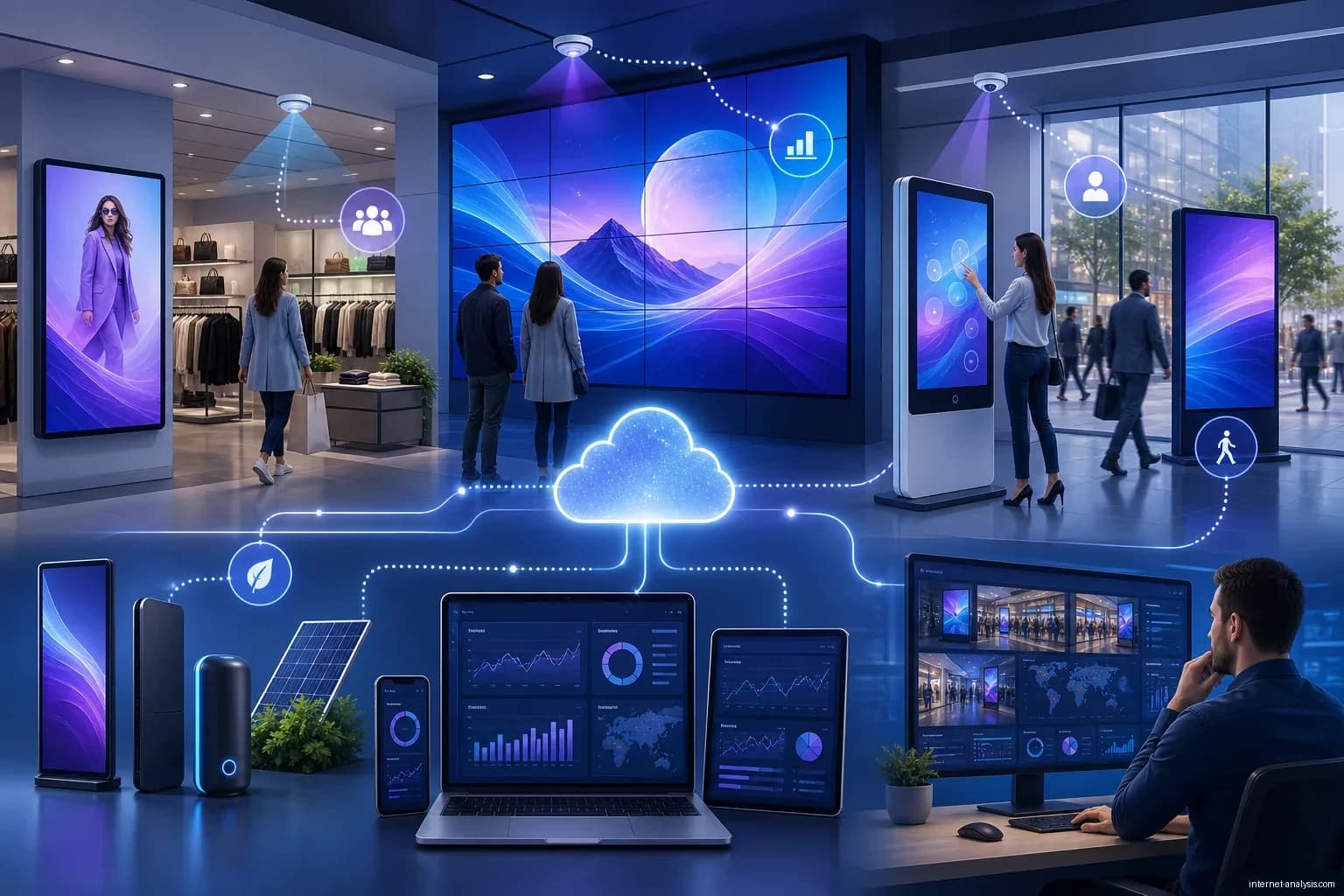
Digital signage is evolving from a collection of screens into an intelligent communications infrastructure. The global market, valued at approximately $29 billion in 2025, is projected to approach $58 billion by 2035 as organizations expand their use of connected displays across retail, workplaces, transportation systems and public spaces.
In 2026, the most consequential developments involve artificial intelligence, cloud management, integrated audiovisual environments, lower operating costs, more affordable LED hardware and software designed for specific industries. Together, these shifts are changing how signage networks are deployed, managed and measured.
1. AI and immersive technology make content more responsive
Artificial intelligence is turning digital signage from a one-way broadcast channel into a system that can adapt content to its context. Modern platforms can analyze audience characteristics, behavioral patterns and engagement data, then select messaging for a particular viewer segment or situation.
Common AI-enabled capabilities include:
- Automated content optimization: Campaigns can respond to foot traffic, weather, time of day and historical performance.
- Sensor integration: Internet of Things devices can supply contextual information that changes what a display presents.
- Machine learning: Systems can refine content strategies as audience behavior and preferences evolve.
- Real-time behavioral analysis: Detected activity can trigger relevant information, promotions or calls to action.
Immersive formats are developing alongside personalization. Three-dimensional product demonstrations, augmented reality and virtual try-on experiences can make displays more interactive without always requiring glasses or other specialized equipment.
Transparent LED panels can place digital information over physical merchandise, connecting an on-screen message with the product behind it. Holographic displays can create floating visuals visible from multiple angles, while gesture-controlled interfaces let people navigate content without touching a screen.
The combination of immersive presentation and AI-based selection is especially significant: the display can provide not only a visually distinctive experience, but one suited to the immediate audience and environment.
2. Cloud platforms become the default management layer
Organizations are continuing to replace on-premises signage systems with cloud-based platforms. Centralized cloud management removes many geographic constraints, allowing teams to supervise hundreds or thousands of displays in different countries from one dashboard.
Central control for distributed networks
A cloud platform can support:
- Immediate network-wide updates: Teams can revise content, schedules and device settings without visiting each location.
- Faster deployment: New sites and campaigns can be launched while retaining consistent brand rules.
- Regional operations: Multilingual content, local customization and time-zone-aware schedules can be managed within the same system.
- Remote device monitoring: Administrators can view endpoint status and investigate problems from a central console.
For global enterprises, this model can reduce deployments that once took weeks to a matter of hours. It also allows local teams to make approved adjustments without fragmenting the broader content strategy.
A smaller infrastructure burden
Cloud architecture can reduce total cost of ownership by removing the need for dedicated on-site servers and associated maintenance. The provider typically manages software updates, security patches and backups, while subscription pricing converts a large capital purchase into a more predictable operating expense.
Encrypted transmission and redundant storage can strengthen resilience, although organizations still need to evaluate a provider’s security, availability and data-governance practices. Cloud systems also make scaling simpler: screens can be added or removed without purchasing more central server capacity.
3. Standalone screens give way to integrated ecosystems
Digital signage planning increasingly covers an entire audiovisual environment rather than isolated endpoints. Displays, media players, speakers, environmental sensors, touch interfaces and business systems can operate as parts of one coordinated network.
A modern store illustrates this transition. A storefront display may attract customers, an interior video wall can promote a seasonal collection, a kiosk can check inventory or order another size, electronic shelf labels can update prices and a checkout display can present an offer informed by purchase history. Instead of operating as five unrelated systems, these touchpoints can be coordinated through one content management platform.
Integrated deployments require content management software that can handle multiple media formats, synchronize playback across devices and process real-time data. They also require careful coordination between hardware and software so that messaging remains consistent at every touchpoint.
Management features required at scale
As networks grow from dozens of displays to hundreds or thousands, manual administration becomes impractical. Enterprise deployments increasingly depend on:
- Role-based access control: Hierarchical permissions can prevent unauthorized changes while allowing regional or local customization within brand guidelines.
- Workflow automation: Approval processes and scheduled publishing reduce manual coordination.
- Proactive monitoring: Automated health checks can identify endpoint failures before they disrupt an audience or violate service commitments.
- Scalable architecture: Microservices and containerized components can help systems expand without a corresponding decline in performance.
Without this foundation, adding screens can create administrative bottlenecks, inconsistent campaigns and slower responses to technical problems.
4. Total cost of ownership and sustainability converge
Purchase price alone no longer provides an adequate measure of a signage investment. Organizations are paying closer attention to electricity consumption, maintenance, uptime, hardware life and replacement schedules. Sustainability is part of the same calculation because lower energy use can reduce both emissions and operating expenses.
Efficient hardware designed for continuous use
Newer LED displays and media players consume less power than previous generations while supporting higher brightness and more accurate color. Next-generation LED technology can use 40% to 60% less energy while producing brighter images, according to the figures supplied for these industry trends.
Potential benefits include:
- Lower electricity bills across large display networks
- Reliable continuous operation during business hours or around the clock
- Fewer service calls and less revenue-disrupting downtime
- Longer component life because efficient hardware generally generates less heat
- Less frequent replacement and lower long-term capital spending
- A smaller operational carbon footprint
These characteristics are particularly important in stores, transit locations and public facilities, where screens may operate for extended periods and downtime is highly visible.
Preventive maintenance and automated failover
Cloud monitoring can identify network interruptions, storage limitations and device-health problems before a complete failure occurs. Remote diagnostics also allow support teams to address many incidents without dispatching a technician.
Failover mechanisms can keep approved content on screen when a primary connection or playback device is unavailable. This resilience applies to networks built around dedicated media players, smart displays or television applications.
Automated reports can combine technical status, proof of playback, content performance and engagement information. The resulting data helps teams improve both the infrastructure and the creative strategy rather than treating maintenance and campaign analysis as separate activities.
5. Falling LED prices broaden access
LED display prices have fallen by more than 60% in recent years, making installations that were once limited to major enterprises more attainable for smaller organizations. Local retailers and restaurants can now consider professional video walls and other large-format experiences that previously exceeded their budgets.
Lower prices are also encouraging adoption in boutique retail, health care and education. The challenge for vendors is to pair increasingly capable hardware with software that nontechnical teams can operate.
Software must scale in both directions
A contemporary content management system may need to support a single display and a multinational network without changing its core user experience. Flexible licenses and feature tiers let organizations begin with a limited deployment and add screens as their needs grow.
Template-based authoring and intuitive workflows help businesses without dedicated design or marketing departments create polished content. Cloud delivery further lowers the barrier by providing access to management and monitoring features without an upfront investment in server infrastructure.
6. Industry-specific software becomes a differentiator
General-purpose playback is no longer sufficient for every deployment. Retailers, restaurants, transportation operators, corporate facilities and educational institutions have distinct workflows, data sources and reliability requirements. Software that supports those requirements directly can produce more value than a generic platform assembled through workarounds.
Retail and restaurant applications
Retail media networks can turn in-store displays into advertising inventory, supported by targeting, scheduling and campaign reporting. Retailers can also use behavioral analytics and heat maps to study engagement patterns and refine content or store layouts.
Quick-service restaurants increasingly connect digital menu boards with point-of-sale and inventory systems. These integrations can change pricing, feature a promotion, support order flow during busy periods and automatically remove unavailable products. Accurate inventory-driven content prevents customers from selecting an item that cannot be fulfilled.
Transportation, corporate and education environments
Mission-critical signage places a higher premium on accuracy, resilience and rapid recovery. Transportation hubs must continue presenting correct passenger information during gate changes, delays and emergencies. Corporate command centers need video walls with accurate color and responsive content switching. Educational institutions may need integrations with room-booking systems, conferencing tools and campus communication networks.
Typical requirements include:
- Redundant failover: Backup systems protect content delivery when a primary component fails.
- Continuous monitoring: Real-time diagnostics give operators an opportunity to respond before an issue affects operations.
- Consistent visual performance: Control rooms and video walls require dependable rendering and low-latency switching.
- Business-system integration: Signage must exchange timely information with operational platforms.
- Enterprise support and testing: Rigorous quality assurance and around-the-clock assistance are essential when failures could affect safety or institutional efficiency.
What these trends mean for signage strategy
The defining shift in 2026 is not simply toward better screens. Digital signage is becoming a connected operational platform that combines content, data, automation and physical infrastructure.
Organizations planning a deployment should evaluate more than display resolution and initial hardware cost. Important questions include whether the system can scale, integrate with existing data, maintain content during an outage, control user permissions, monitor endpoints remotely and document long-term energy and maintenance costs.
AI and immersive formats may attract attention, but their value depends on a dependable cloud and hardware foundation. Likewise, lower LED prices create opportunities only when the accompanying software remains manageable. The strongest deployments will align creative ambition with reliable infrastructure, measurable operations and requirements specific to the industry in which the screens operate.
Frequently asked questions
What are the leading digital signage trends for 2026?
The principal trends are AI-driven personalization, immersive visual formats, cloud-based management, integrated audiovisual ecosystems, greater emphasis on total cost of ownership, more affordable LED hardware and specialized software for individual industries.
How can cloud software reduce total cost of ownership?
Cloud platforms eliminate many on-premises server expenses and shift updates, backups and routine maintenance to the service provider. Subscription pricing can make costs more predictable, while remote monitoring, diagnostics and failover reduce downtime and the number of on-site service visits.
Why is AI becoming important to digital signage?
AI allows content to respond to audience behavior and contextual signals such as weather, traffic and time of day. It can also use engagement results to refine future content choices, turning a static display into a platform that continuously adjusts its messaging.
Is LED signage affordable for small businesses?
LED prices have declined substantially, including a reported drop of more than 60% in recent years. Combined with cloud software and flexible subscriptions, that decline has made professional display networks more accessible to smaller businesses, although installation, energy, maintenance and content-production costs must still be considered.

Tomasz
Founder and network data analyst at Internet AnalysisTomasz leads data-focused analysis at Internet Analysis, covering connection performance, broadband infrastructure and ISP services. He connects measurable network indicators with explanations that help readers make informed decisions.
View author profile →How this article was prepared
He checks metric definitions, compares equivalent samples and examines geographic and time coverage before drawing conclusions. His analytical writing follows causal relationships, compares possible explanations and states where the evidence ends.
Read our methodology →Reviewed by the Internet Analysis Editorial Team
Reviewed by the Internet Analysis Editorial Team · Updated August 16, 2026
Meet the editorial team →Article context, review and related questions
Digital signage in 2026 is being reshaped by AI personalization, immersive displays, cloud management, integrated infrastructure, lower operating costs and industry-specific software.
| Measure | Value | Context |
|---|---|---|
| Article type | Technology | Editorial classification |
| Reading time | 9 minutes | Estimated at approximately 220 words per minute |
| Editorial review | Internet Analysis Editorial Team | Updated August 16, 2026 |
| Review date | August 16, 2026 | Latest stored article update |
Methodology
He checks metric definitions, compares equivalent samples and examines geographic and time coverage before drawing conclusions. His analytical writing follows causal relationships, compares possible explanations and states where the evidence ends.
Full methodology →Data freshness
- Page updated
- Data period
- August 16, 2026
- Responsible editor
- TomaszFounder and network data analyst
Primary sources
- Internet Analysis editorial methodologyReview and limitation rules
Limitations
- The article is informational and may simplify technical details for readability.
- Products, standards, prices and service availability can change after the review date.
- The latest review date does not guarantee that every external product or service remains unchanged.
Related questions
What is the main point of “Six Digital Signage Trends Shaping 2026”?
Digital signage in 2026 is being reshaped by AI personalization, immersive displays, cloud management, integrated infrastructure, lower operating costs and industry-specific software.
How was this article prepared?
He checks metric definitions, compares equivalent samples and examines geographic and time coverage before drawing conclusions. His analytical writing follows causal relationships, compares possible explanations and states where the evidence ends.
When was this information last reviewed?
The latest stored review or update date is August 16, 2026.