Where Logistics Operations Lose Money—and How to Recover It
Learn how to identify hidden logistics costs, quantify process waste and recover value through process redesign, system integration, automation and targeted AI.
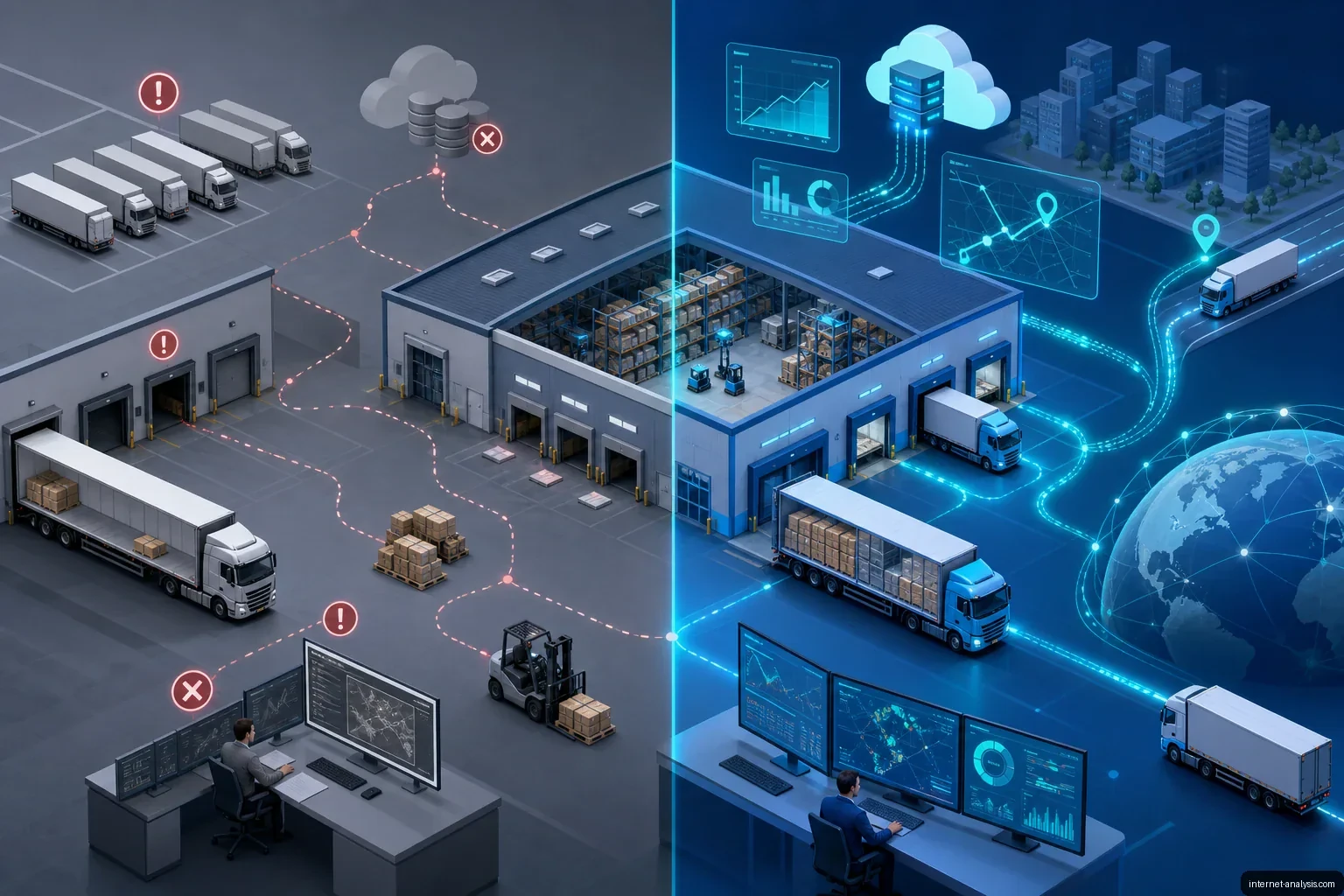
Logistics losses rarely arrive as one dramatic expense. More often, money slips away through recurring document corrections, empty miles, warehouse mistakes, missing assets, delayed updates and decisions made with incomplete information.
These small inefficiencies form an operational tax that may never appear as a distinct line item. Recovering the money requires more than cutting a major budget or installing a single tool. Companies must identify where work, data and responsibility break down, then redesign and automate the right processes.
Where hidden logistics costs accumulate
Traditional cost reports emphasize fuel, transportation, warehousing, labor and claims. Those categories matter, but they do not always reveal the underlying cause of an expense. Many losses originate where processes and systems intersect—for example, when employees reenter data, a warehouse management system holds different information from a transportation management system, or a customer receives an update too late.
Manual work and document corrections
An incorrect order value, missing shipping document or delayed confirmation can generate calls, corrections, claims and additional trips. The original mistake may take seconds to make, while resolving its consequences consumes time across operations, customer service, finance and transportation.
Manual activity is especially costly when it occurs at high volume. A five-minute task performed occasionally is minor; the same task repeated thousands of times becomes a substantial labor expense and creates repeated opportunities for error.
Fragmented operational visibility
When shipment, pallet, load-carrier and inventory statuses are scattered among spreadsheets, emails and disconnected platforms, the company pays for uncertainty. Employees make extra calls, repeatedly check information and maintain larger operational buffers because they cannot trust a single source of truth.
Limited visibility also delays decisions. By the time a team identifies a late shipment, missing asset or inventory discrepancy, the least expensive corrective options may no longer be available.
Underused transportation capacity
Empty miles, weak return-trip planning, poorly selected routes, unused loading windows and unsynchronized dock appointments do not necessarily cause an obvious operational failure. They steadily reduce asset utilization and increase the cost of every shipment.
The issue is often broader than route planning. Transportation utilization depends on timely order data, warehouse readiness, carrier capacity, delivery constraints and appointment information. If those inputs are incomplete or late, even a capable planning system will produce weaker results.
Waiting, walking and searching in warehouses
Warehouse waste does not always generate an invoice. Employees may spend time walking unnecessarily, waiting for instructions, looking for goods, confirming completed steps or requesting status updates. Forklifts may make avoidable trips, while teams compensate for unreliable information with extra handling and inventory.
These activities are easy to normalize because they happen every day. Direct observation and process analysis are often necessary to measure their cumulative cost.
Exception handling and constant firefighting
Every logistics network encounters exceptions. The warning sign is an operation in which exceptions have become the standard way of working. Teams then depend on individual experience, calls and improvised workarounds instead of a repeatable process.
Firefighting is expensive because it diverts skilled employees from planning and improvement. It also makes performance difficult to scale: increasing shipment volume creates a corresponding increase in manual intervention.
Why financial reports understate the problem
Hidden logistics costs are difficult to assign to one department. A delayed status update might consume time in transportation, customer service and sales. A missing load carrier may create search time, replacement expense, equipment rental and an extra trip. Each cost appears in a different budget, obscuring their common cause.
The result is not one large spreadsheet entry but hundreds of small losses, such as:
- minutes spent checking or reentering information;
- document corrections and repeated approvals;
- calls to carriers, warehouses and customers;
- unnecessary forklift movements or handling steps;
- unused or missing load carriers;
- claims caused by incomplete records;
- extra inventory held because demand or lead-time data is unreliable;
- decisions delayed while employees reconcile conflicting information.
McKinsey has reported that successful adopters of AI-enabled supply-chain management achieved improvements of 15% in logistics costs, 35% in inventory levels and 65% in service levels compared with slower-moving competitors. These results should not be treated as a guaranteed return for every implementation, but they illustrate the potential scale of inefficiency in fragmented operations.
McKinsey has also identified fragmented data, outdated infrastructure and limited end-to-end visibility as continuing barriers to generative AI in supply chains. Technology cannot compensate for inaccessible, inconsistent or poorly governed operational data.
A practical framework for reducing losses
Effective cost reduction typically combines process mapping, system integration and targeted automation. The sequence matters: automating a poorly defined workflow can accelerate mistakes rather than eliminate them.
1. Audit the operation
Begin by mapping how orders, shipments, documents, assets and exceptions move through the business. The audit should capture both the official workflow and the workarounds employees use in practice.
For each step, record:
- the person or system responsible;
- the required input and its source;
- the output produced;
- the average handling and waiting time;
- the number of handoffs;
- the frequency and cost of errors;
- common exceptions and escalation paths;
- duplicate entry, approval or verification work.
The purpose is not to search immediately for an AI application. It is to find measurable points where time, capacity, assets or information are being lost.
2. Redesign the process before automating it
A process should have a defined trigger, owner, decision logic, data requirements and completion condition. Unnecessary approvals and duplicate checks should be removed before implementation. Exceptions should be categorized rather than handled as unrelated emergencies.
This stage also distinguishes between valuable controls and avoidable bureaucracy. Removing every human review may create new risks, while preserving redundant reviews limits the benefit of automation.
3. Connect operational systems
Logistics depends on data moving among enterprise resource planning, warehouse management, transportation management, customer relationship management, carrier, marketplace and document platforms. When these systems do not exchange information reliably, employees become the integration layer.
System and API integration can reduce reentry, shorten update delays and establish consistent status information. Good integration also requires data ownership, validation rules, error handling and monitoring. Moving incorrect data faster is not an improvement.
4. Apply automation and AI selectively
Rules-based automation is often appropriate for repetitive, predictable work. Potential applications include document generation, status notifications, data validation, routine approvals and exception routing.
AI may provide additional value when a task involves forecasting, classification, optimization or analysis of complex operational data. Maersk has described potential uses for generative AI that include forecasting demand patterns and lead times, improving reorder points and safety stock, and automating freight and documentation verification.
More specialized models may be useful when a company has unique operating logic, historical data or internal terminology. However, a custom model still needs a defined business objective, suitable data, measurable performance criteria and human oversight.
5. Monitor the production system
Implementation is not the end of the project. APIs change, shipment volumes fluctuate and operating procedures evolve. Automated workflows therefore need ongoing monitoring, maintenance and support.
Teams should track failed transactions, data-quality problems, processing delays, model performance and the rate of manual intervention. A system that quietly shifts work back to employees can appear operational while its expected savings disappear.
How to calculate logistics automation ROI
A basic cost model can expose the value of a repetitive workflow:
Process cost = handling time × transaction volume × hourly labor cost + error cost + delay cost
The calculation should use fully loaded labor cost where possible and should account for everyone involved in corrections or escalations—not only the employee performing the initial task.
A useful comparison includes the following components:
| Cost or benefit | What to measure |
|---|---|
| Labor time | Minutes spent entering data, checking status, calling partners, correcting records and approving work |
| Error cost | Claims, incorrect documents, warehouse mistakes, rework and reshipments |
| Delay cost | Detention, missed appointments, expedited transportation, lost capacity and service penalties |
| Asset utilization | Empty miles, load factor, equipment dwell time, asset-pool size and missing equipment |
| Inventory impact | Safety stock, stockouts, excess inventory and working capital |
| Technology cost | Implementation, integration, licensing, infrastructure, training, monitoring and maintenance |
| Scalability | Additional volume handled without proportional staffing growth |
Annual net benefit can be estimated by subtracting recurring technology and operating costs from annual savings. A simple payback period divides the initial implementation cost by the expected monthly net benefit. More substantial investments may also require discounted cash-flow analysis.
Expected benefits should be tested against a baseline and measured after deployment. Without baseline data, teams may attribute normal volume changes or seasonal variation to the new system.
Evidence from transportation and asset management
AI-enabled supply-chain management
McKinsey reported that early adopters of AI-enabled supply-chain management improved logistics costs by 15%, inventory levels by 35% and service levels by 65%. The associated capabilities included stronger forecasting, broader visibility and dynamic optimization.
The figures demonstrate potential rather than a universal outcome. Actual results depend on process maturity, data quality, adoption and the specific constraints of an operation.
DHL transportation analytics
DHL reported distance savings of 5.4 million kilometers in the EMEA region during the first six months of a transportation analytics implementation covering approximately 21,000 shipments. The approach used centralized data and analytics to identify backhaul and route-combination opportunities and improve network utilization.
This example shows why transportation optimization requires more than a standalone routing calculation. Centralized, usable network data can reveal combinations that remain hidden when planning is divided among locations or systems.
DHL load-carrier tracking
In another case, DHL addressed the management of roller cages across a network of more than 6,000 convenience stores. Slow asset turnover and missing equipment were contributing to rental, replacement and additional transportation costs.
An Internet of Things tracking and monitoring platform provided information about dwell time, exceptions and accountability across the network. DHL reported lower costs and fewer resources devoted to missing-asset claims, a smaller asset pool and less reliance on alternative transportation equipment.
Common mistakes that undermine savings
Focusing only on the largest invoices
Major spending categories deserve scrutiny, but they may conceal the process failures driving the expense. A company can negotiate a lower transportation rate while continuing to pay for avoidable miles, delays and corrections.
Automating a broken workflow
If employees follow inconsistent rules or rely on incomplete data, automation may reproduce those problems at higher speed and volume. Standardization and process design should come first.
Starting with technology instead of a business case
Reuters, citing Gartner, has reported the risk that some agentic AI projects will be discontinued when they lack clear business value. Logistics initiatives should therefore begin with a measurable problem, baseline and accountable owner—not a visually impressive demonstration.
Ignoring employees and operational knowledge
Warehouse and logistics automation generally works best when it complements human labor rather than treating automation as a simple replacement. Employees understand recurring exceptions and informal dependencies that may not appear in process documentation.
A practical division of work assigns predictable, high-volume tasks to automation while people handle judgment, relationships, unusual exceptions and continuous improvement. Training and feedback mechanisms are essential to adoption.
Overlooking maintenance and change management
An automation can lose value when interfaces change, data definitions drift or employees return to old workarounds. Ownership, support procedures and performance reviews should be established before production deployment.
What logistics teams can do now
- Select one high-friction process. Choose a workflow that generates frequent calls, corrections, delays or escalations.
- Measure minutes and volume. Count how long each check, clarification and correction takes, then multiply it by transaction frequency.
- Map the data flow. Document how information moves among ERP, WMS, TMS, CRM, carrier and document systems.
- Track exceptions. Group claims, incomplete data, missed appointments and manual overrides by cause.
- Review mobile assets. Measure dwell time, loss frequency and replacement costs for pallets, cages, containers and other load carriers.
- Establish a baseline. Record current cost, cycle time, error rate and service performance before changing the process.
- Prioritize by value and feasibility. Address processes with high volume, repeatable rules, reliable data and measurable financial impact first.
Frequently asked questions
Where is money most often lost in logistics?
Common sources include manual corrections, delayed information, empty miles, documentation errors, poor asset visibility, unnecessary warehouse movement and disconnected systems. These losses frequently overlap and affect several departments.
How can a company reduce logistics costs without lowering quality?
Start by removing non-value-added work, improving information quality and increasing operational visibility. Automate high-volume, repetitive tasks while preserving human review for consequential decisions and unusual exceptions. Cost, service and error metrics should be monitored together.
Is logistics automation worthwhile for a midsize company?
It can be, particularly when operations rely heavily on email, spreadsheets and manual data entry. The decision should be based on transaction volume, current process cost, implementation expense and measurable expected savings rather than company size alone.
Where should an operating-cost reduction program begin?
Begin with a process and data audit. It should identify handoffs, delays, workarounds, system gaps and exception costs. This prevents the company from implementing a tool that does not address the actual constraint.
Does AI replace people in logistics?
AI is better treated as part of a hybrid operating model. Automation can process repetitive work and analyze large data sets, while employees manage exceptions, relationships, judgment and improvement. The appropriate balance depends on the task and the consequences of an error.
Recovering the operational tax
The strongest logistics savings programs do not begin with a broad promise to “use AI.” They begin with a specific loss: an avoidable trip, a repeated correction, an idle asset or a delayed decision. Once the cost is measured, the company can determine whether the answer is process redesign, integration, automation, AI—or a combination of all four.
Small leaks deserve attention because they recur. Fixing one well-chosen, high-volume process can recover capacity, reduce errors and create a foundation for broader operational improvement.

Tomasz
Founder & Network Data Analyst at Internet AnalysisTomasz leads data-focused analysis at Internet Analysis, covering internet speed, latency, reliability, broadband infrastructure, and ISP performance. His work connects measurable network indicators with clear explanations for everyday users.
View author profile →How this article was prepared
Reviews measurement definitions, compares like-for-like network samples, checks geographic and time coverage, and documents limitations before drawing conclusions.
Read our methodology →Reviewed by the Internet Analysis Editorial Team
Reviewed by the Internet Analysis Editorial Team · Updated August 16, 2026
Meet the editorial team →Article context, review and related questions
Learn how to identify hidden logistics costs, quantify process waste and recover value through process redesign, system integration, automation and targeted AI.
| Measure | Value | Context |
|---|---|---|
| Article type | Supply Chain Technology | Editorial classification |
| Reading time | 11 minutes | Estimated at approximately 220 words per minute |
| Editorial review | Internet Analysis Editorial Team | Updated August 16, 2026 |
| Review date | August 16, 2026 | Latest stored article update |
Methodology
Reviews measurement definitions, compares like-for-like network samples, checks geographic and time coverage, and documents limitations before drawing conclusions.
Full methodology →Data freshness
- Page updated
- Data period
- August 16, 2026
- Responsible editor
- TomaszFounder & Network Data Analyst
Primary sources
- Internet Analysis editorial methodologyReview and limitation rules
Limitations
- The article is informational and may simplify technical details for readability.
- Products, standards, prices and service availability can change after the review date.
- The latest review date does not guarantee that every external product or service remains unchanged.
Related questions
What is the main point of “Where Logistics Operations Lose Money—and How to Recover It”?
Learn how to identify hidden logistics costs, quantify process waste and recover value through process redesign, system integration, automation and targeted AI.
How was this article prepared?
Reviews measurement definitions, compares like-for-like network samples, checks geographic and time coverage, and documents limitations before drawing conclusions.
When was this information last reviewed?
The latest stored review or update date is August 16, 2026.