How to Build an AI Agent: A Practical Development Guide
Learn how to define, design, secure, test, deploy, and maintain an AI agent using language models, reinforcement learning, and supporting development tools.
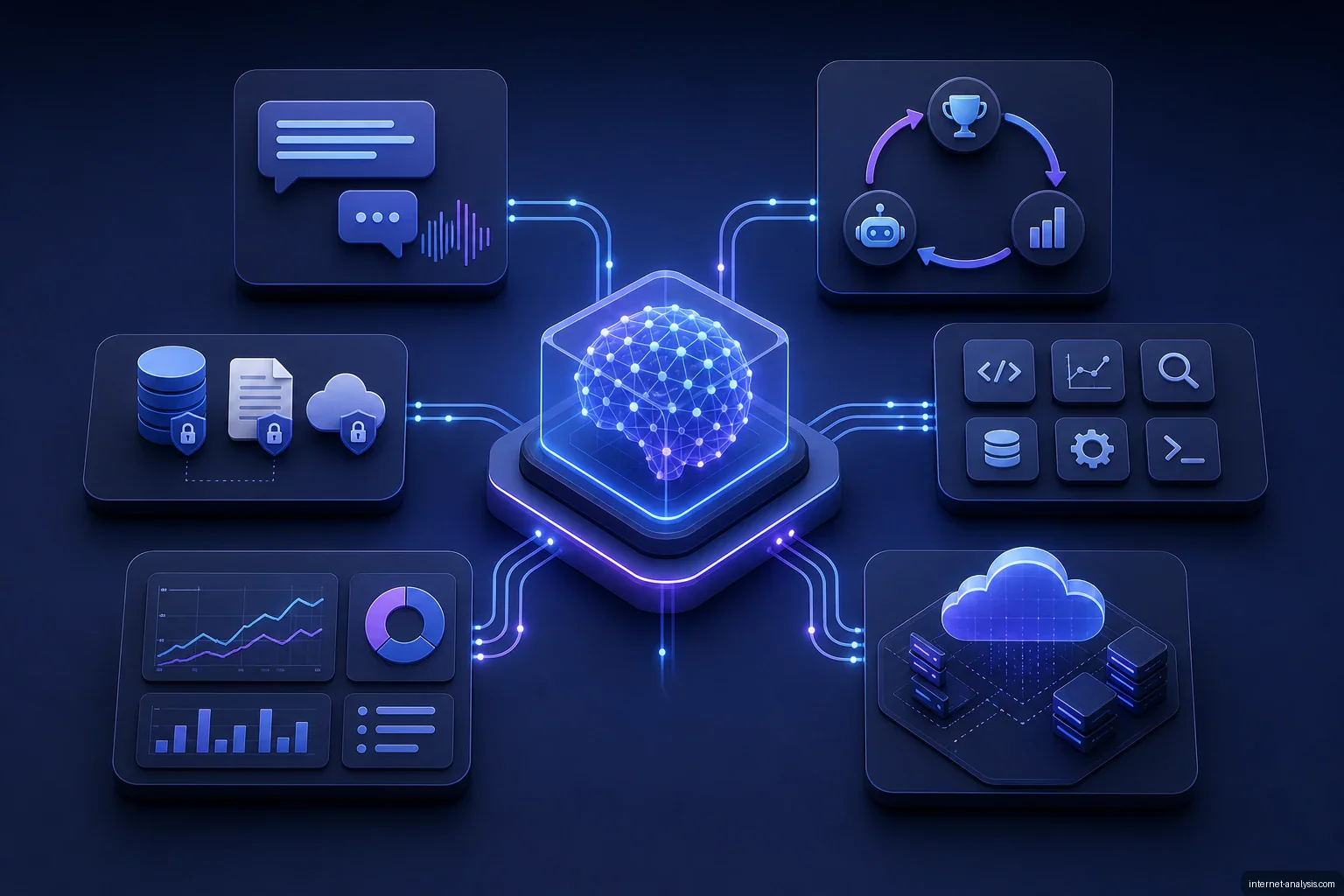
AI agents can automate repetitive work, analyze information, support decisions, and interact with users through natural language. Building one, however, requires more than connecting a model to a chat interface. A dependable agent needs a defined purpose, an appropriate architecture, secure access to data and tools, measurable performance targets, and a plan for ongoing maintenance.
The right development path depends on what the agent must accomplish. A text-focused assistant may rely on a large language model, while a system that learns through repeated interaction may use reinforcement learning. Some applications combine both approaches. This guide explains the major decisions involved, from defining the problem to operating the finished system at scale.
1. Define the agent’s purpose
Start with a specific need rather than a broad goal such as “use AI.” A precise purpose keeps the project focused and helps determine what data, models, integrations, infrastructure, and evaluation methods will be required.
Identify the primary task
Describe the job the agent is expected to perform, who will use it, what information it needs, and which actions it is permitted to take. Potential applications include:
- Customer support: Answering common questions, retrieving account information, or routing complex cases to employees.
- Supply management: Forecasting demand, monitoring inventory, and recommending logistics routes.
- Content recommendations: Evaluating user behavior to suggest relevant products, articles, or videos.
- Fraud detection: Monitoring transactions and identifying activity that requires investigation.
- Cybersecurity: Analyzing network activity, detecting anomalies, and helping teams respond to potential threats.
- Data analysis: Collecting information from approved sources, applying calculations, and presenting useful findings.
- Content processing: Generating drafts, summarizing documents, classifying text, or extracting structured information.
The scope should also define what the agent must not do. Limits on data access, financial transactions, account changes, external communication, or other sensitive actions reduce operational and security risks.
Document the requirements
Once the task is clear, translate it into technical and operational requirements. Important considerations include:
- Data: Identify the information needed for training, retrieval, decision-making, and evaluation. Confirm that it is accurate, available, and legally usable.
- Computing resources: Estimate processing, memory, storage, and network requirements for both development and production.
- Deployment environment: Determine whether the agent will run in the cloud, on company infrastructure, on an edge device, or across several environments.
- Integrations: List the databases, APIs, business applications, sensors, or user interfaces the agent must use.
- Response expectations: Define acceptable latency, availability, output quality, and workload capacity.
- Human oversight: Decide when the agent may act independently and when it must request approval or transfer control to a person.
A documented scope makes architecture decisions easier and provides a baseline for testing whether the completed agent meets its intended requirements.
2. Select the appropriate type of agent
The agent’s task should determine its underlying approach. Language models are suited to natural-language work, while reinforcement learning is useful when behavior must improve through interaction and feedback.
Language-model agents
An agent based on a large language model, or LLM, can interpret instructions and generate natural-language output. Depending on its configuration and integrations, it may also retrieve documents, call software tools, query databases, or coordinate a multistep workflow.
Common LLM-agent applications include:
- Conversational customer-service systems
- Document summarization and question answering
- Drafting articles, reports, emails, or marketing material
- Extracting information from unstructured text
- Assisting with research, coding, and internal knowledge retrieval
The language model alone does not make the overall system reliable. Developers must also control its context, permissions, tool access, error handling, and response validation.
Reinforcement-learning agents
Reinforcement learning, or RL, is designed for situations in which an agent takes actions in an environment and receives feedback in the form of rewards or penalties. Over repeated interactions, it learns a policy intended to improve cumulative reward.
This approach can be appropriate for dynamic tasks such as computer games, robotics, resource allocation, or control systems. Its design requires a clearly represented environment, a defined set of possible actions, and a reward function that accurately reflects the desired behavior. If the reward is poorly designed, the agent may optimize the metric without producing the intended result.
Reactive and deliberative behavior
Agents can also be distinguished by how they make decisions:
- Reactive agents respond to current input without depending heavily on stored experience or long-term planning. Fast anomaly detection is one possible use because the system must evaluate incoming events immediately.
- Deliberative agents use accumulated information, reasoning, and planning to compare possible actions. Autonomous navigation is an example: the system may assess routes, constraints, and predicted outcomes before selecting a maneuver.
Many practical systems combine the two. They react quickly to urgent events while using memory or planning for tasks that require context and multiple steps.
Combining LLMs and reinforcement learning
An agent can use both language processing and reinforcement-learning methods. In a hybrid design, an LLM may interpret instructions or communicate with users, while an RL component learns behavior from interactions with an environment. This can support conversational systems that adapt over time or dynamic learning applications that must both understand language and choose actions.
The components should still be evaluated separately. Fluent communication does not prove that an action policy is safe, and improved rewards do not guarantee accurate language output.
3. Design the agent architecture
A production agent is usually a collection of components rather than a single model. Its architecture may include:
- Input processing: Validates and converts user requests, documents, events, or sensor data into a usable form.
- Model or decision engine: Interprets the input and selects a response or action.
- Memory and state: Preserves information required across messages, tasks, or environmental changes.
- Knowledge retrieval: Locates relevant material from approved databases or document collections.
- Tools and integrations: Allow the agent to call APIs, run approved functions, or interact with business systems.
- Control logic: Manages sequencing, retries, time limits, permissions, and conditions for human escalation.
- Output validation: Checks responses or proposed actions before they reach a user or external system.
- Monitoring: Records performance, failures, resource consumption, and security-relevant activity.
The architecture should use the least access necessary. For example, an agent that only needs to read order status should not receive permission to modify or cancel orders.
4. Choose frameworks and libraries
Frameworks and libraries provide reusable components for model development, data processing, simulation, and testing. Choosing them according to the project’s requirements can reduce development time and avoid unnecessary custom code.
Model-development frameworks
- TensorFlow: Supports the construction, training, and deployment of machine-learning models.
- PyTorch: Provides flexible tools for designing and training neural-network architectures.
Both can be used to model specialized architectures or simulate phenomena when the underlying problem can be represented appropriately. The decision between them should account for the team’s experience, deployment environment, ecosystem compatibility, and performance needs.
Supporting libraries
- Gym: Provides standardized environments and interfaces for experimenting with reinforcement-learning algorithms.
- spaCy: Offers natural-language-processing capabilities such as tokenization, entity recognition, and linguistic analysis.
- NumPy: Supplies numerical arrays and mathematical operations used throughout scientific and machine-learning software.
An LLM-based project may also require a model provider, an agent-orchestration or management library, retrieval components, data connectors, and monitoring software. Tool selection should follow the architecture instead of determining it.
5. Build security and privacy into the system
Security is a core design requirement, especially when the agent can access confidential information or perform actions in external systems.
- Follow applicable requirements: Identify relevant laws, contractual obligations, organizational policies, and industry standards before processing data.
- Protect infrastructure: Use reliable hosting, encryption, secure credential storage, network controls, and strong authentication.
- Apply access controls: Restrict each user, service, and agent tool to the permissions needed for its role.
- Minimize data: Collect and retain only the information required for the task. Apply anonymization or other privacy protections where appropriate.
- Validate inputs and outputs: Treat user instructions, retrieved documents, and tool responses as potentially unsafe. Check proposed actions before execution.
- Maintain audit records: Log important decisions, tool calls, errors, approvals, and configuration changes.
- Provide human escalation: Route uncertain, sensitive, or high-impact cases to qualified people.
Security controls should cover the entire system, not only the model. APIs, databases, plugins, interfaces, and deployment pipelines can all introduce vulnerabilities.
6. Define evaluation metrics before launch
Evaluation criteria should be established early so the team can compare designs and determine whether the agent is ready for use. The correct metrics depend on the task.
For classification and detection systems, common measures include:
- Accuracy: The proportion of all predictions that are correct.
- Precision: The proportion of positive predictions that are actually positive.
- Recall: The proportion of relevant positive cases the system successfully identifies.
These metrics reveal different aspects of performance. In fraud detection, for example, a team may need to balance catching suspicious transactions against producing too many false alerts.
Language and workflow agents may require additional measurements, including task-completion rate, factual correctness, response relevance, tool-call success, latency, cost, escalation frequency, and user satisfaction. Reinforcement-learning systems should be assessed not only by reward but also by stability, safety constraints, and performance in scenarios that differ from training.
Testing should use realistic tasks, including normal requests, unusual inputs, incomplete information, integration failures, and attempts to make the agent exceed its authority. High-impact applications require particularly careful review and human oversight.
7. Implement and integrate the agent
After selecting the architecture and tools, implement the agent’s operating logic and connect it to its data sources and permitted actions. A typical sequence is:
- Prepare and validate the required data.
- Configure or train the selected model.
- Implement state, memory, retrieval, and tool-calling logic as needed.
- Connect the agent to a chat interface, web application, internal system, or device.
- Add authentication, authorization, logging, and output checks.
- Test individual components before evaluating complete workflows.
- Run realistic pilot scenarios with limited permissions and human review.
- Address failures before gradually expanding access or workload.
Keeping model logic separate from business rules and integrations can make the system easier to test, replace, and maintain.
8. Deploy, monitor, and scale
Deployment is not the end of development. Models, data, user behavior, and connected services change over time, so an agent requires continuous observation and maintenance.
Monitor production behavior
Track errors, response quality, latency, resource use, tool failures, security events, and changes in task performance. Monitoring should make it possible to identify the version of the model, instructions, data source, and configuration involved in an incident.
Maintain the system
Ongoing work may include software updates, security patches, data-quality checks, model or prompt revisions, integration repairs, and improvements based on user feedback. Changes should be tested before release to ensure that fixing one workflow does not damage another.
Plan for growth
Scaling may require additional computing capacity, caching, workload distribution, rate limits, or a different model strategy. The goal is not merely to handle more requests, but to maintain consistent results as usage increases. Cost, latency, reliability, and quality should be evaluated together.
Common questions about building AI agents
What is the basic process for building an AI agent?
Define the task and boundaries, choose an appropriate model and architecture, identify the required data and tools, implement the operating logic, integrate a user interface, secure the system, and test it with realistic scenarios. After deployment, monitor performance and maintain the agent continuously.
How should an AI model be selected?
Choose according to the task, available data, complexity, performance requirements, deployment constraints, and budget. Comparing multiple models with the same representative evaluation set can show which one best meets the project’s needs.
What tools are required?
The exact toolchain varies, but it may include a machine-learning framework such as TensorFlow or PyTorch, numerical and data-processing libraries, a language model or model provider, an agent-management layer, databases or retrieval systems, deployment infrastructure, and performance-monitoring software. Collaboration and project-management tools also help coordinate development.
Can an LLM and reinforcement learning be used together?
Yes. An LLM can handle language understanding and generation, while reinforcement learning can help an agent adapt its action policy through feedback. The hybrid system still requires carefully designed rewards, permissions, safety controls, and separate evaluation of its language and decision-making behavior.
What are familiar examples of AI assistants?
Widely known conversational assistants illustrate several capabilities associated with agent systems:
- ChatGPT: Generates conversational responses and helps users complete language-based tasks.
- Google Assistant: Handles voice requests, information retrieval, tasks, and compatible smart-home controls.
- Amazon Alexa: Supports voice commands, information access, automation, and connected devices.
- Apple Siri: Responds to voice requests and performs supported actions across Apple devices and applications.
- Microsoft Copilot: Provides AI assistance for productivity, coding, and document-related work. It is distinct from Cortana, Microsoft’s earlier digital assistant.
Not every conversational assistant is fully autonomous. What makes a system agentic is its ability to pursue a defined objective by selecting actions, using available tools or information, and operating within established constraints.
Build for a defined outcome
A successful AI agent begins with a narrow, measurable objective and a realistic understanding of the environment in which it will operate. Model selection matters, but architecture, data quality, permissions, evaluation, security, and maintenance are equally important.
By defining boundaries early, selecting technology according to the task, testing complete workflows, and monitoring production behavior, teams can create agents that remain useful and dependable as requirements evolve.

Anna
Digital Safety & Consumer Research Editor at Internet AnalysisAnna edits practical guidance about safer internet use, privacy, online services, and consumer decisions. She prioritizes clear recommendations, scope, and transparent sourcing.
View author profile →How this article was prepared
Reviews claims against named primary or authoritative sources, removes unsupported certainty, distinguishes general education from professional advice, and records the article update date.
Read our methodology →Reviewed by the Internet Analysis Editorial Team
Reviewed by the Internet Analysis Editorial Team · Updated August 28, 2026
Meet the editorial team →Article context, review and related questions
Learn how to define, design, secure, test, deploy, and maintain an AI agent using language models, reinforcement learning, and supporting development tools.
| Measure | Value | Context |
|---|---|---|
| Article type | Artificial Intelligence | Editorial classification |
| Reading time | 10 minutes | Estimated at approximately 220 words per minute |
| Editorial review | Internet Analysis Editorial Team | Updated August 28, 2026 |
| Review date | August 28, 2026 | Latest stored article update |
Methodology
Reviews claims against named primary or authoritative sources, removes unsupported certainty, distinguishes general education from professional advice, and records the article update date.
Full methodology →Data freshness
- Page updated
- Data period
- August 28, 2026
- Responsible editor
- AnnaDigital Safety & Consumer Research Editor
Primary sources
- Internet Analysis editorial methodologyReview and limitation rules
Limitations
- The article is informational and may simplify technical details for readability.
- Products, standards, prices and service availability can change after the review date.
- The latest review date does not guarantee that every external product or service remains unchanged.
Related questions
What is the main point of “How to Build an AI Agent: A Practical Development Guide”?
Learn how to define, design, secure, test, deploy, and maintain an AI agent using language models, reinforcement learning, and supporting development tools.
How was this article prepared?
Reviews claims against named primary or authoritative sources, removes unsupported certainty, distinguishes general education from professional advice, and records the article update date.
When was this information last reviewed?
The latest stored review or update date is August 28, 2026.