What Is Multimodal AI? How It Works and Where It Is Used
Learn how multimodal AI combines text, images, audio, video and sensor data, as well as how the technology is used in healthcare, robotics, search and document analysis.
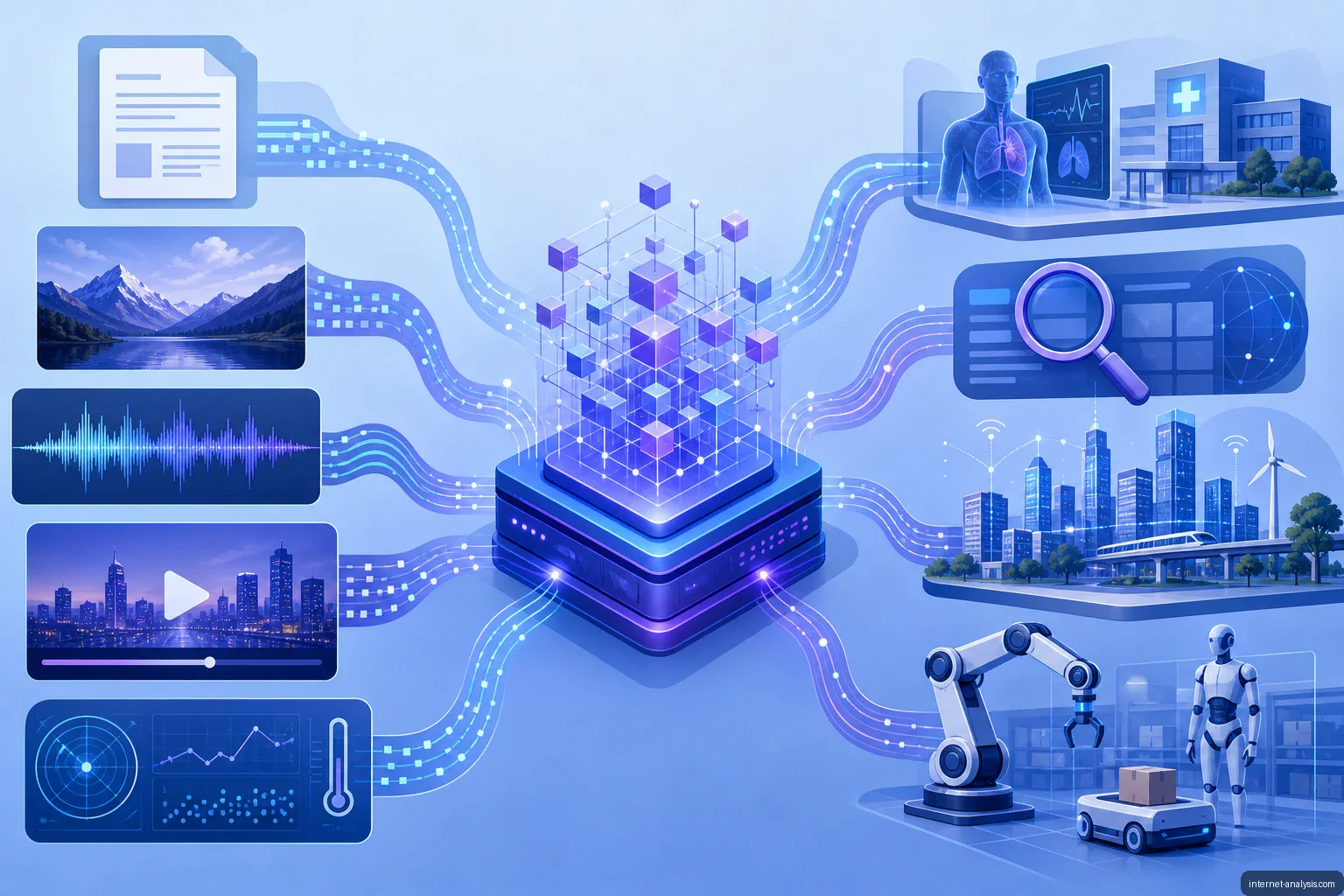
Multimodal artificial intelligence can process and connect multiple forms of information, including text, images, audio, video and sensor readings. Instead of treating each input as an isolated signal, a multimodal system builds a combined representation that can provide more context for analysis, generation and decision-making.
This approach supports interactions that more closely resemble human communication. A person might ask a spoken question about an object in a photo, for example, or submit a document containing paragraphs, tables and diagrams. A capable multimodal model can consider those elements together rather than requiring separate systems for every data type.
What is multimodal AI?
Multimodal AI is a category of artificial intelligence designed to work with two or more data modalities. A modality is a distinct way of representing information, such as:
- Text: documents, messages, transcripts and structured records
- Images: photographs, scans, diagrams and medical imaging
- Audio: speech, music and environmental sounds
- Video: sequences combining visual movement, timing and often sound
- Sensor data: temperature, motion, distance, pressure, location and other measurements
- Robotic signals: tactile feedback, joint positions and proprioceptive data
A single-modality model might classify an image or summarize a block of text. A multimodal model can relate the image to a written description, answer questions about it or compare it with information in another source. The defining capability is not merely accepting different file types; it is connecting evidence across them.
How multimodal models work
Multimodal systems generally need a way to encode each input, align related information and combine the resulting representations. The exact architecture varies, but the process commonly includes several stages.
Encoding each modality
Raw inputs have different structures. Text consists of tokens, images contain spatial pixel patterns, audio unfolds over time and sensors produce numerical streams. Specialized encoders transform these inputs into machine-readable representations, often called embeddings or features.
Aligning related information
The system must learn which elements correspond across modalities. It may associate a phrase with an area of an image, match a spoken sentence to its transcript or connect a moment in a video with an action described in text. This alignment enables the model to reason about relationships rather than process parallel inputs independently.
Fusing information
After encoding and alignment, the system combines relevant features. Fusion may occur early in processing, later in the model or through repeated exchanges between modality-specific components. The objective is to preserve useful signals from each source while producing a coherent view of the task.
Producing an output
The combined representation can support classification, prediction, retrieval, recommendations, generated text or other actions. A multimodal assistant, for instance, could analyze an uploaded chart and explain its findings in natural language. A robot could combine a camera feed, spoken instructions and distance measurements to choose its next movement.
Why multiple modalities matter
Information from one source is often incomplete or ambiguous. Combining modalities can help a system resolve uncertainty, verify observations and account for context that would otherwise be missing.
- Richer context: Tone of voice can change the meaning of spoken words, while gestures and facial expressions can add further clues.
- Cross-checking: Written statements can be compared with images, recordings or sensor readings when those sources are relevant to the task.
- More natural interaction: Users can communicate through speech, text or visual input instead of translating every request into a rigid format.
- Better situational awareness: Systems operating in physical environments can combine cameras, microphones and sensors to form a broader view of current conditions.
- More flexible outputs: The same underlying system may support visual questions, document analysis, transcription and content generation.
More data does not automatically guarantee better results. Inputs can conflict, sensors can fail and training data can contain errors or bias. Effective multimodal systems therefore require careful data preparation, evaluation and mechanisms for handling uncertainty.
Applications of multimodal AI
Healthcare and medical analysis
Healthcare applications can combine medical images with textual patient records. An analysis might consider an X-ray or MRI scan alongside medical history, clinical notes and other relevant information. Connecting these sources can help identify patterns that may be less apparent when each is reviewed alone.
Such systems should support qualified professionals rather than be treated as independently authoritative. Medical deployment requires rigorous validation, privacy protections and clear oversight because errors can have serious consequences.
Virtual assistants and conversational systems
Multimodal assistants can respond to spoken language while considering visual context. A user could point a camera at an object and ask a question about it, or request an explanation of content displayed on a screen. Systems designed for richer interaction may also use gestures or other visual cues when appropriate and permitted.
This combination can make communication more intuitive, particularly when describing an image in words would be slow or imprecise.
Document understanding
Documents often convey meaning through more than text. Page layout, tables, signatures, diagrams, scanned images and handwritten annotations can all be important. Multimodal document systems can analyze these visual features alongside extracted language.
In legal and business review, a system might compare contract language with associated images or recordings when those materials form part of the evidence. Potential benefits include faster review, improved retrieval and a lower risk of overlooking relevant nontextual information. Human review remains essential for consequential interpretations.
Search, web content and video analysis
Multimodal search can index and retrieve information based on relationships among text, images, audio and video. A product search, for example, could account for written reviews as well as demonstrations shown in videos. A user could also search with an image rather than relying only on keywords.
For video platforms, models can consider dialogue, on-screen text, objects, scenes and actions. These signals can assist with content categorization, recommendations and finding specific moments within long recordings.
Sensor networks and smart cities
Urban systems generate information through traffic cameras, weather stations, environmental monitors and other sensors. Integrating these streams can produce a more unified view of traffic flow, weather conditions and environmental changes.
Because sensor data arrives continuously, multimodal processing can also support real-time situational awareness. A system may detect changing conditions and update predictions or operational decisions as new evidence appears. Combining sources can reveal patterns that are difficult to identify from a single sensor, although reliability depends on calibration, data quality and appropriate governance.
Multimodal AI in robotics
Robots must interpret dynamic physical environments, where no single sensor provides a complete picture. Cameras can show objects and obstacles, microphones can capture commands, distance sensors can estimate proximity and tactile sensors can indicate physical contact.
Combining visual, audio and sensory inputs
A multimodal robot can integrate these streams in real time. It might locate an object visually, interpret a spoken instruction and use force or distance feedback while moving it. This coordination can improve:
- Task accuracy by supplying context from multiple sources
- Human-machine interaction through speech, gestures and visual references
- Adaptability when conditions differ from an expected setup
- Environmental awareness by reducing dependence on any one sensor
Perception and movement
Visual and audio data help a robot understand external events, while tactile and proprioceptive signals provide information about contact and the robot’s own position. Combining these inputs can support more precise responses and dynamic adjustment during a task.
These capabilities are relevant to areas such as manufacturing and healthcare, where robots may need to operate near people or handle variable objects. Usability and trust depend not only on performance but also on predictable behavior, safeguards and clear limits on autonomy.
Environmental monitoring and disaster response
Future robotic systems could combine environmental measurements, imagery and location data to monitor ecological change, inspect hazardous areas or support disaster response. The same principles may also contribute to autonomous systems used in smart-city projects.
NVIDIA is among the companies investing in multimodal AI for robotics, including GPU-based computing architectures and AI models intended to improve real-time perception and decision-making. Progress in this area could accelerate machines’ ability to interpret complex environments, though deployment still requires testing for safety and reliability.
Multimodal AI compared with traditional AI
Traditional AI systems are often developed for one narrowly defined input and task, such as classifying images or analyzing text. Multimodal AI instead connects information across data types. However, the boundary is not absolute: some modern generative AI systems are multimodal, while others remain limited to a single modality.
The practical difference lies in the system’s ability to establish relationships across inputs. A text-only model can analyze a transcript, but it cannot independently inspect the associated facial expressions or visual events. A multimodal model may evaluate all of those elements together to create a broader interpretation.
Challenges and limitations
Building a multimodal system introduces complexity beyond that of a single-input model. Important challenges include:
- Data alignment: Training examples must accurately connect related text, images, audio or sensor events.
- Uneven data quality: One noisy modality can distort the system’s overall interpretation.
- Conflicting evidence: Models need reliable ways to respond when sources disagree.
- Computing requirements: Processing high-resolution imagery, long video and continuous sensor streams can be resource-intensive.
- Privacy: Audio, video, medical records and location data may contain sensitive personal information.
- Bias: Gaps or imbalances in training data can produce inconsistent performance across people, languages and environments.
- Evaluation: Testing must cover each modality, their interactions and realistic combinations of failure conditions.
- Explainability: In high-stakes settings, operators need to understand which evidence affected a result.
The future of multimodal systems
Multimodal AI is likely to play an expanding role in assistants, analytics, robotics and autonomous systems because real-world tasks rarely arrive as clean, text-only inputs. Systems that can relate language to sights, sounds and physical measurements are better positioned to operate within complex environments.
The technology’s value will depend on more than the number of modalities a model supports. Useful systems must combine information accurately, recognize uncertainty and protect the people whose data they process. When those requirements are met, multimodal AI can make digital tools more contextual, flexible and natural to use.
Frequently asked questions
What is multimodal AI?
Multimodal AI refers to systems that process and connect two or more types of data, such as text, images, audio, video and sensor measurements. The goal is to create a more complete interpretation than any one source can provide alone.
How does it improve contextual understanding?
It combines complementary signals. A system analyzing both speech and video, for example, can consider verbal content alongside visual events or expressions. This may reduce ambiguity and reveal context that is missing from a transcript alone.
What are its main applications in robotics?
Robotic applications include perception, spoken-command processing, navigation, object handling and real-time decision-making. Cameras, microphones, tactile feedback, distance measurements and proprioceptive data can work together to help a robot understand and respond to its surroundings.
Is all generative AI multimodal?
No. Generative AI describes systems that create content, while multimodal AI describes systems that work across multiple data types. A generative model may be text-only, or it may accept and produce several modalities.

Anna
Digital Safety & Consumer Research Editor at Internet AnalysisAnna edits practical guidance about safer internet use, privacy, online services, and consumer decisions. She prioritizes clear recommendations, scope, and transparent sourcing.
View author profile →How this article was prepared
Reviews claims against named primary or authoritative sources, removes unsupported certainty, distinguishes general education from professional advice, and records the article update date.
Read our methodology →Reviewed by the Internet Analysis Editorial Team
Reviewed by the Internet Analysis Editorial Team · Updated August 28, 2026
Meet the editorial team →Article context, review and related questions
Learn how multimodal AI combines text, images, audio, video and sensor data, as well as how the technology is used in healthcare, robotics, search and document analysis.
| Measure | Value | Context |
|---|---|---|
| Article type | Artificial Intelligence | Editorial classification |
| Reading time | 9 minutes | Estimated at approximately 220 words per minute |
| Editorial review | Internet Analysis Editorial Team | Updated August 28, 2026 |
| Review date | August 28, 2026 | Latest stored article update |
Methodology
Reviews claims against named primary or authoritative sources, removes unsupported certainty, distinguishes general education from professional advice, and records the article update date.
Full methodology →Data freshness
- Page updated
- Data period
- August 28, 2026
- Responsible editor
- AnnaDigital Safety & Consumer Research Editor
Primary sources
- Internet Analysis editorial methodologyReview and limitation rules
Limitations
- The article is informational and may simplify technical details for readability.
- Products, standards, prices and service availability can change after the review date.
- The latest review date does not guarantee that every external product or service remains unchanged.
Related questions
What is the main point of “What Is Multimodal AI? How It Works and Where It Is Used”?
Learn how multimodal AI combines text, images, audio, video and sensor data, as well as how the technology is used in healthcare, robotics, search and document analysis.
How was this article prepared?
Reviews claims against named primary or authoritative sources, removes unsupported certainty, distinguishes general education from professional advice, and records the article update date.
When was this information last reviewed?
The latest stored review or update date is August 28, 2026.